“Talk to me, Harry Winston, tell me all about it!” That unforgettable line from Marilyn Monroe’s iconic performance of “Diamonds Are a Girl’s Best Friend” in the 1953 film Gentlemen Prefer Blondes cemented Harry Winston’s name in popular culture forever. More than seven decades later, the House of Harry Winston has transformed that cultural moment into an extraordinary high jewelry collection that tells the story of its legendary founder and his revolutionary approach to diamonds, design, and the magic of Hollywood.
The Talk to Me, Harry Winston collection isn’t simply a showcase of exceptional gemstones—though it certainly features those in abundance. It’s a narrative journey through three distinct chapters of Harry Winston’s legacy, each one illuminating a different facet of the man known throughout the world as the “King of Diamonds.” Through these breathtaking one-of-a-kind creations, the House celebrates its glamour, artistry, and brilliance while honoring the visionary whose philosophy continues to guide it today.
Chapter One: King of Diamonds
The first chapter of the Talk to Me, Harry Winston collection celebrates the title bestowed upon Harry Winston by Cosmopolitan magazine in 1947—a recognition of his status as the preeminent dealer in the world’s most exceptional diamonds. This chapter features one-of-a-kind creations that showcase the magnificence of the finest gemstones, each piece embodying Winston’s philosophy that beautiful gems deserve to be celebrated and shared with the world.
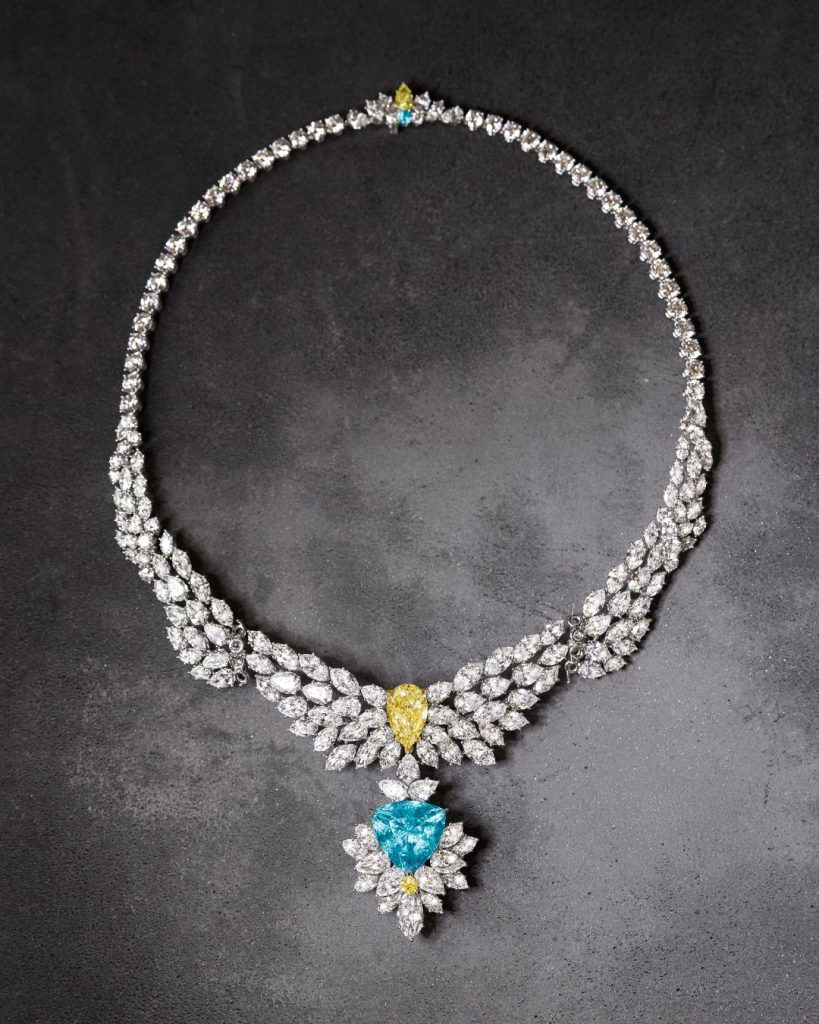
The centerpiece of this chapter is a breathtaking creation featuring a 16.10 carat Paraiba tourmaline center stone—one of the rarest colored gemstones on earth. These electric blue-green stones, found only in limited deposits in Brazil and, more recently, in Mozambique and Nigeria, are prized for their unique neon quality caused by traces of copper. Accented by a luminous 5.01 carat yellow diamond and more than 65 carats of additional diamonds, this piece captures the drama and rarity that defined Winston’s approach to high jewelry.

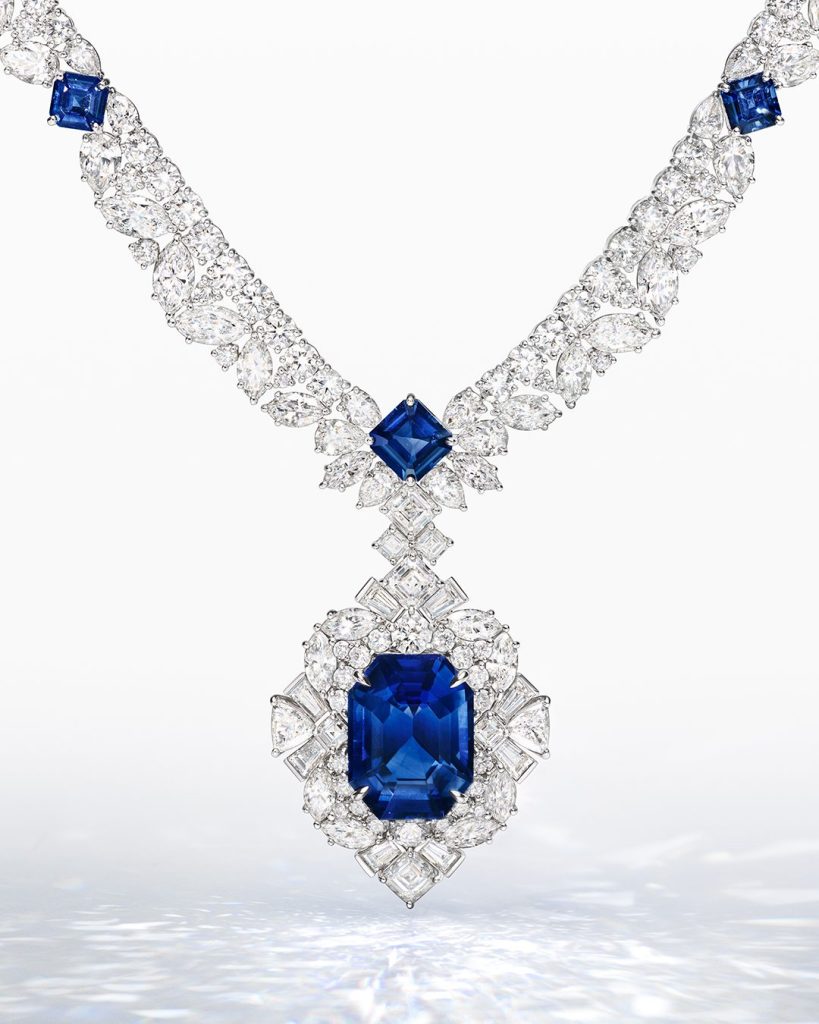

Another exceptional suite within this chapter features rare octagonal sapphires that exemplify the House’s genius for gems. This creation unites the structured elegance of the Art Deco era with contemporary sophistication, demonstrating how geometric precision can enhance rather than constrain a gemstone’s natural beauty. The octagonal cut—an emerald cut variation with eight sides—emphasizes clarity and color while creating striking visual impact, particularly when repeated across a suite of matching stones.

The chapter also features a timepiece that elevates horological artistry to new heights, with a pavé yellow diamond dial complemented by Asscher-cut yellow diamonds along the bracelet. This watch demonstrates that even in horology, the House remains committed to its founding principle: let the diamonds define the design.
Chapter Two: Rare Jeweler of the World
The second chapter explores Harry Winston’s reputation as the “Rare Jeweler of the World”—a title earned through his remarkable eye for gemstones and his genius in setting them to their best advantage. This chapter features one-of-a-kind creations that transform incredible gemstones and innovative designs into veritable works of art, full of movement and life.
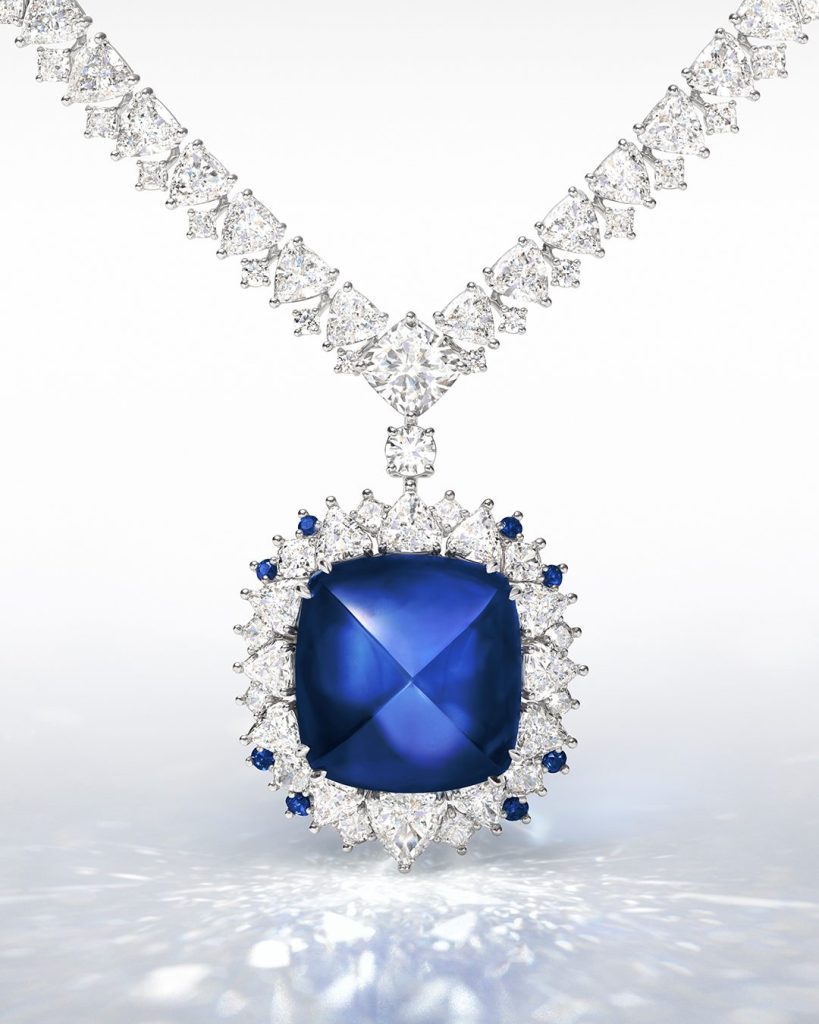
The crown jewel of this chapter is a necklace showcasing a magnificent 65.61 carat sugarloaf sapphire poised at the center of a composition comprised of custom-cut pyramid-shaped diamonds. The sugarloaf cut—a domed cabochon with a square or rectangular base—was particularly favored during the Art Deco period for its ability to showcase a gemstone’s color and luster without the distraction of facets. At over 65 carats, this Kashmir sapphire represents the pinnacle of colored gemstone rarity, with its velvety blue hue considered the most desirable of all sapphires.
The surrounding pyramid-shaped diamonds required exceptional skill to create. Each stone had to be custom-cut to precise specifications, then set in a way that allows light to flow through the entire composition. The result is a necklace that feels simultaneously architectural and organic, structured yet flowing. Indeed, a perfect embodiment of Winston’s ability to unite exceptional stones with visionary design.
Another highlight of the “Rare Jeweler of the World” chapter is the Yellow Diamond and Diamond Suite—a dazzling collection that celebrates the elegance of pear-shaped diamonds, a signature of Winston design for nearly a century. From a necklace to a tiara, the suite sparkles with a medley of pear-shaped diamonds crowned by exceptional, fancy-intense yellow center stones, each piece radiating golden brilliance. The pear shape, with its combination of the marquise and oval cuts, has long been favored by Harry Winston for its ability to maximize a diamond’s brilliance while creating graceful, elongated silhouettes.
Chapter Three: Jeweler to the Stars
The third and final chapter celebrates Harry Winston’s enduring legacy as “Jeweler to the Stars”—the title he earned by revolutionizing the relationship between high jewelry and Hollywood glamour. Winston understood the transformative power of jewels on the red carpet, where diamonds could turn a moment into legend. Under flashing lights and the gaze of the world, his creations sparkled like no other, creating unforgettable moments that continue to define red carpet style today.
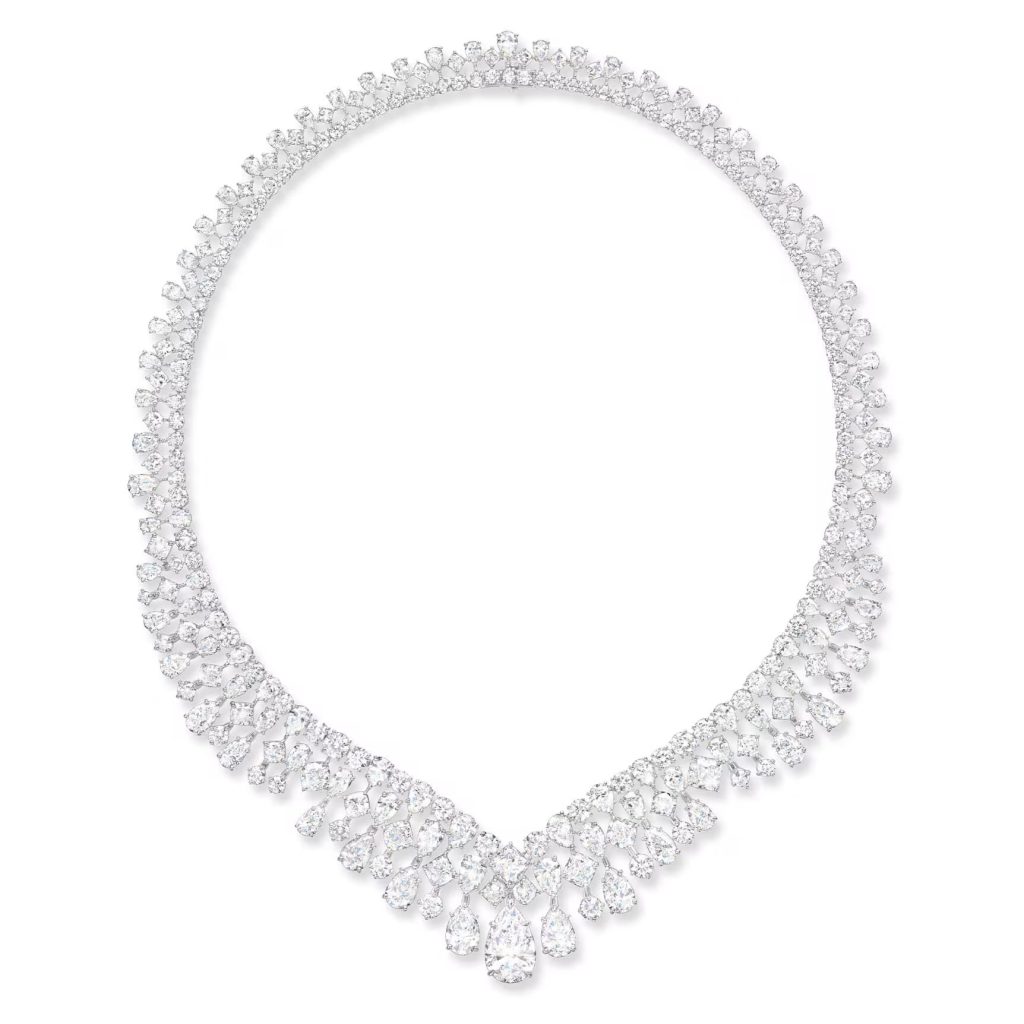
The signature piece of this chapter glitters with 266 diamonds in a fluid V-shaped design, finished with a magnificent 5.03 carat pear-shaped diamond. This one-of-a-kind creation evokes Winston’s belief that Hollywood’s brightest moments deserve jewels as exceptional as the stars themselves. The V-shape creates dramatic lines that elongate the neck and draw the eye, while the graduated diamond sizes create mesmerizing movement with every gesture. When worn on the red carpet, such a piece doesn’t simply adorn—it transforms, creating that ineffable quality of star power that separates a beautiful woman from an icon.
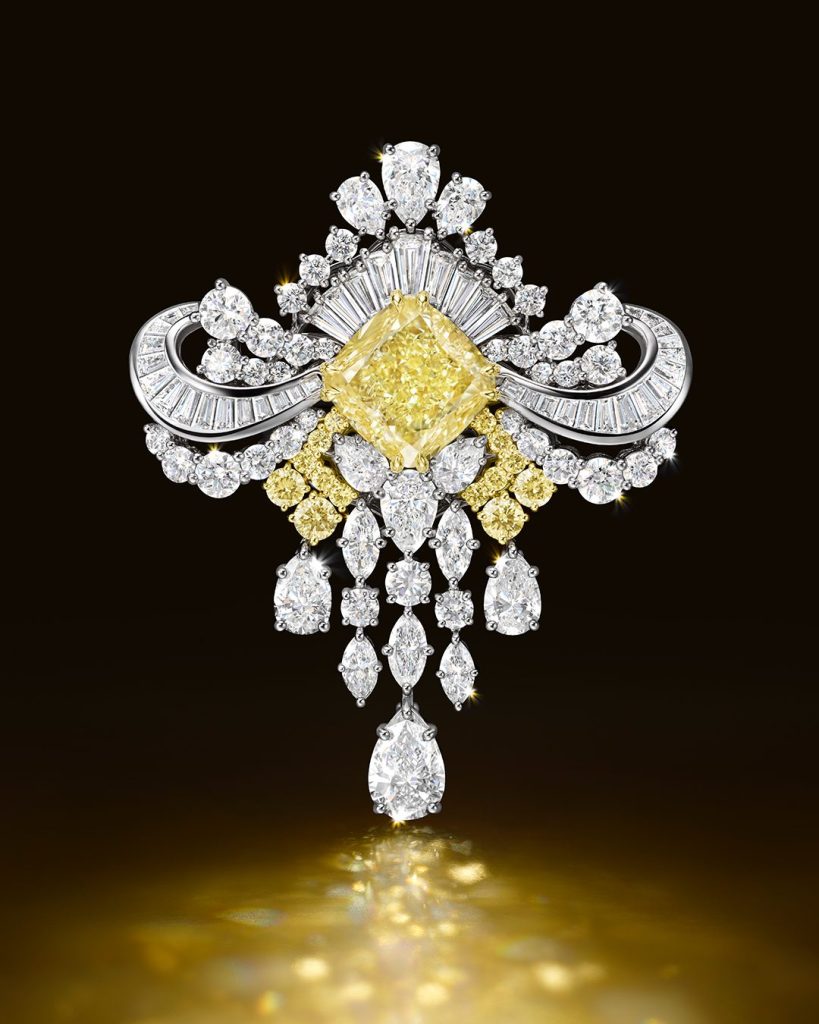
Another show-stopping creation in this chapter is a brooch that captures Winston’s flair for spectacle, centered on a 9.81-carat fancy intense yellow diamond. Cascading strands and looping ribbons of diamonds add drama and movement, creating a piece that seems almost alive with energy. This brooch exemplifies the “Winston Cluster” motif—that signature setting style first developed in the 1940s by designer Nevdon Koumrouyan and master craftsman Ambaji Shinde, who was inspired by the way frost forms on holly leaves. By arranging diamonds in varying cuts and sizes in three-dimensional compositions, the Winston Cluster achieves extraordinary light reflection and movement, setting Harry Winston jewelry apart from all competitors.
The Hollywood Connection
The name “Talk to Me, Harry Winston” itself celebrates one of the most successful marketing moments in jewelry history—though it wasn’t actually marketing at all. When the 1953 film “Gentlemen Prefer Blondes” was released, Marilyn Monroe’s performance of “Diamonds Are a Girl’s Best Friend” became an instant cultural phenomenon. The line “Talk to me, Harry Winston, tell me all about it!” made Winston a household name overnight, connecting his brand indelibly with Hollywood glamour, feminine power, and the transformative magic of diamonds.

But Winston’s connection to Hollywood went far deeper than a single movie reference. In 1944, he pioneered the practice that would become standard in luxury jewelry: lending pieces to actresses for major events. The first beneficiary was Jennifer Jones, who wore Harry Winston jewels to the Academy Awards. The practice continued throughout the Golden Age of Hollywood, with stars like Katharine Hepburn, Lauren Bacall, and, of course, Marilyn Monroe wearing Winston creations on the red carpet.
The Art of Letting Diamonds Speak
What unites all three chapters of the Talk to Me, Harry Winston collection is the founding principle that has guided the House since 1932: the beauty of a diamond should speak for itself. Harry Winston believed that the most perfect stones deserved settings that enhanced rather than competed with their natural brilliance.

This philosophy manifests in the collection’s use of invisible platinum settings—a Winston signature since the beginning. By crafting settings in platinum so fine they virtually disappear, the House allows the gemstones to appear as if they’re floating, held in place by nothing but light itself. This technical mastery requires extraordinary skill from the master jewelers who create each piece, as the settings must be simultaneously invisible and secure enough to protect gems worth millions of dollars.

The collection also demonstrates Winston’s genius for combining stones of different cuts and colors in harmonious compositions. Rather than creating monochromatic pieces or relying on a single stone to carry the design, Winston understood how to make different gemstones enhance each other. A yellow diamond becomes more luminous when paired with white diamonds. A blue sapphire appears more vivid against platinum and diamonds. A Paraiba tourmaline’s electric intensity is amplified by the warm glow of yellow diamonds surrounding it.
Featured images: Harry Winston

Amanda Akalonu is dedicated to weaving together the worlds of jewelry, watches, and objects through a lens of literary storytelling.