I’ll admit it: when I first heard that Louis Vuitton and Takashi Murakami were reuniting for another collaboration, my heart did a little skip. It’s been over two decades since these two titans of art and luxury first joined forces, and their partnership has fundamentally changed how we think about the intersection of contemporary art and fashion. Now, with the unveiling of the Louis Vuitton Artycapucines VII collection at Art Basel Paris 2025, they’re proving that magic doesn’t fade—it only gets bolder, stranger, and more wonderfully surreal.
A Love Story Twenty Years in the Making
Let me take you back to 2003. Marc Jacobs was at the helm of Louis Vuitton, and he made what would become one of the most influential decisions in luxury fashion history: he tapped Takashi Murakami to reimagine the brand’s monogram. The result? The iconic Monogram Multicolore collection that brought psychedelic pops of color to the storied French house and made waiting lists stretch around the block. Rihanna has one. Kendall Jenner has one. These weren’t just handbags. They were cultural artifacts that marked a seismic shift in how luxury brands engaged with contemporary art.
Fast forward to October 2025, and the partnership has come full circle with the Louis Vuitton Artycapucines VII collection. This isn’t simply a nostalgic callback; it’s a full-throttle celebration of artistic collaboration that pushes boundaries even further than before. As Murakami himself told Elle Decor, “Fashion has become more artistic than before, and art, in turn, must assert even deeper conceptual meaning to keep up. I feel this creates a sort of creative chase, where both are constantly challenging and redefining each other.”
An Octopus Takes Over Paris
The launch itself is nothing short of theatrical. Picture this: an eight-meter-tall inflatable octopus suspended from the Balcon d’Honneur at the Grand Palais, its tentacles sprawling across the floor in a riot of color and pattern. This isn’t just decoration—it’s a Murakami sculpture inspired by Chinese lanterns, adorned with his signature Jellyfish Eyes motif and serving as the spectacular backdrop for the collection itself.
I wish I could have seen it in person. The installation reportedly transforms the historic space into Murakami’s universe, complete with carpeting printed with octopus tentacles and those mesmerizing spherical Plush Balls he’s been creating since 1995. Among them sits a brand-new Cherry Blossom Plush Ball, created specifically for Art Basel Paris, drawing inspiration from the delicate sakura flowers of Japanese cherry trees. The eleven pieces of the Louis Vuitton Artycapucines VII collection are displayed within this immersive environment, blurring the line between art exhibition and product launch in the most Murakami way possible.
The Bags: Where Sculpture Meets Function
Now let’s talk about the real stars of the show—the bags themselves. The Louis Vuitton Artycapucines VII features eleven pieces, and calling them “handbags” feels almost reductive. These are wearable sculptures, each one a testament to Louis Vuitton’s technical mastery and Murakami’s boundless imagination.
Capucines BB Golden Garden

The Capucines BB Golden Garden is perhaps the most elegant of the collection, and it absolutely radiates grace. Imagine gold-leaf-covered leather adorned with intricate floral marquetry and enamel-painted details. The design draws from Murakami’s interpretation of Ogata Kōrin’s Flowers, bringing classical Japanese artistry into conversation with contemporary luxury. It’s the kind of piece that would look equally at home in a museum vitrine or on your arm at a gallery opening.
Capucines Mini Mushroom

If the Golden Garden is elegant, the Capucines Mini Mushroom is pure whimsy. This one stopped me in my tracks when I first saw the images. Over 100 hand-polished resin mushrooms—each one 3D-printed—are emblazoned across mirrored canvas, creating what can only be described as a dazzling, dreamlike forest you can carry. It’s maximalism at its finest, transforming Murakami’s flat artwork into a tactile, three-dimensional experience. The mushrooms catch the light differently depending on how you hold the bag, making it a constantly shifting visual experience.
Capucines Mini Tentacle

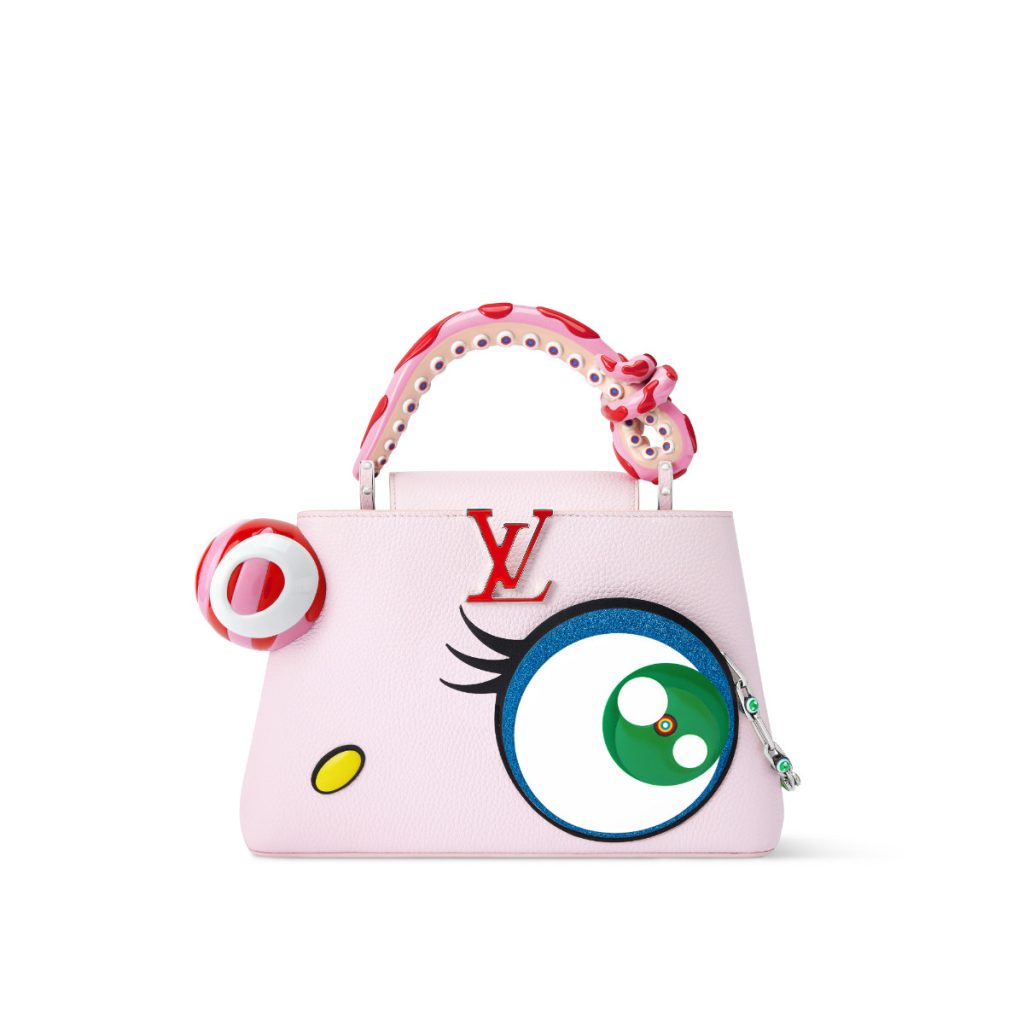
Then there’s the Capucines Mini Tentacle, which takes kawaii culture and turns it up to eleven. Japanese artistry meets playful motifs as Murakami reimagines his iconic Mr. DOB character as a vibrant octopus, with seven red-and-pink tentacles wrapping around and over the bag’s surface. It’s a callback to his sculptural piece “DOBtopus” and embodies that peculiar Murakami magic—something that’s simultaneously cute and slightly unsettling, childlike yet deeply conceptual. The piece demonstrates the “prismatic fusion of craftsmanship and whimsy” that defines the entire collection.
Beyond the Big Three
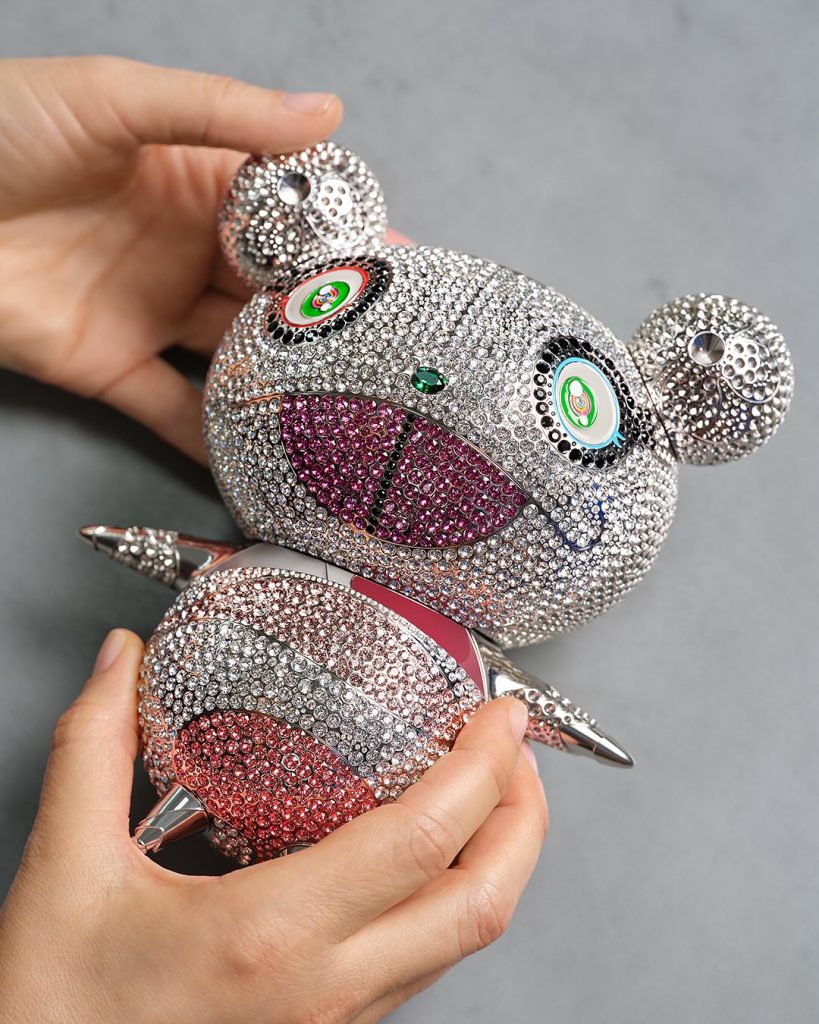
While those three pieces showcase the range of the collection, the other eight designs are equally extraordinary. The Panda Clutch might be my personal favorite—a glittering, bedazzled tribute to Murakami’s Panda character from Superflat Monogram, the short film he produced during that first 2003 collaboration. Reportedly studded with thousands of crystals, it’s pure sparkle and nostalgia wrapped into one.

There’s also the Capusplit BB, which features a double-layered design with blue crocodile leather that opens to reveal an interior patterned with the famous Monogram Multicolore—a literal peek into the history of this partnership. The Capucines East West Dragon presents an entirely new silhouette, specially designed to accommodate a small-scale rendering of Dragon in Clouds Indigo Blue, one of Murakami’s largest known artworks from 2010.

And for those who prefer something bold and unisex, the XXL Camo reconfigures the Capucines into an oversized, baggy design with a casual green-toned camouflage pattern—but look closer, and you’ll see the pattern is actually made of skulls. Murakami never does anything by halves.

Why I Love This Collection

The timing of the Louis Vuitton Artycapucines VII collection is significant beyond the Art Basel Paris calendar. The luxury goods market is experiencing its first major slowdown since the 2008-2009 financial crisis, following an extraordinary post-pandemic boom. In this environment, collaborations like this aren’t just about creating beautiful objects. They’re about reinforcing brand value through cultural capital and artistic legitimacy.

Louis Vuitton has been playing this game brilliantly since Gaston-Louis Vuitton commissioned artists in the 1920s. They’ve collaborated with Sol LeWitt, Richard Prince, Yayoi Kusama, and countless others. But the Murakami partnership remains the gold standard, the collaboration that proved contemporary art and luxury fashion could create something entirely new together.
What strikes me most about this reunion is how it speaks to the endurance of genuine creative partnership. This isn’t Louis Vuitton simply licensing Murakami’s imagery—it’s a true collaboration where each party pushes the other to new heights. As Murakami noted, fashion and art are engaged in a “creative chase, where both are constantly challenging and redefining each other.”
The Celebrity Factor
Of course, we can’t ignore the cultural cachet. The original 2003 collaboration became instant celebrity catnip, and the Louis Vuitton Artycapucines VII is following suit. Zendaya, who fronted the campaign for last year’s Louis Vuitton x Murakami reunion, has been carrying the bags everywhere, from campaign shoots to London street style moments. When someone of Zendaya’s cultural influence champions a collection, you know it’s going to sell out fast.
And it will sell out—these are “highly limited-edition” pieces, which in luxury-speak means if you want one, you’d better act immediately. The pre-orders are already open at Louis Vuitton stores, but given the celebrity demand and collector interest, I’d imagine many pieces are already spoken for.
The Verdict

Standing back and looking at the Louis Vuitton Artycapucines VII collection as a whole, what impresses me most is how it refuses to play it safe. Twenty years after their first collaboration, Murakami and Louis Vuitton could have coasted on nostalgia. Instead, they’ve created something that feels simultaneously familiar and completely new—bags that are unabashedly joyful, technically extraordinary, and conceptually rich.
These pieces transcend their function as accessories. The Capucines Mini Mushroom with its forest of resin fungi, the tentacle-wrapped Mini Tentacle, the shimmering Panda Clutch—these aren’t bags you buy simply to carry your essentials. They’re conversation starters, collectible art pieces, and wearable manifestations of Murakami’s technicolor universe.
In a world where luxury can sometimes feel predictable, the Louis Vuitton Artycapucines VII reminds us that true collaboration between artists and houses can still surprise and delight us. It’s a testament to both Murakami’s relentless creativity and Louis Vuitton’s willingness to embrace the unexpected. And honestly? In 2025, when so much feels uncertain, I’ll take all the joy, color, and artistic playfulness I can get, even if it comes in the form of a handbag covered in hand-polished mushrooms.
Images: Courtesy of Louis Vuitton

Amanda Akalonu is dedicated to weaving together the worlds of jewelry, watches, and objects through a lens of literary storytelling.