When I first laid eyes on Lladró’s new interpretation of The Guest, my breath caught in a way I did not anticipate. Porcelain, I’ve always believed, carries a quiet kind of magic, a delicacy that teeters between fragility and permanence. Yet here was a piece that transcended mere elegance. It vibrated with personality, with movement, and with the unmistakable signature of its creator—Spanish artist Juan Díaz-Faes.
The Guest has long been a cornerstone of Lladró’s narrative-rich High Porcelain line, a figurative exploration of human presence and emotional resonance. In Díaz-Faes’ hands, this beloved icon has been reimagined for a contemporary audience, combining geometric whimsy with the timeless materiality of porcelain. It is both approachable and extraordinary, playful and thoughtful. It’s a reminder that true artistry need not choose between rigor and imagination.
Lladró The Guest by Juan Díaz-Faes: A Contemporary Interpretation of a Classic Character
The original Guest designs have always invited intimacy. They are characters frozen in moments of quiet engagement—waiting, observing, or sharing a secret with the viewer. Díaz-Faes’ version, sculpted by Raul Rubio, amplifies this sense of invitation, yet transforms it through geometry and rhythm. His work is instantly recognizable: looping faces, undulating forms, hypnotic patterns that feel both modern and timeless.
Looking at the sculpture, I was struck by the way the curves and lines dance across the surface. From a distance, the figure appears almost abstract, a silhouette captured mid-thought. Up close, the precision of the hand-painted motifs becomes clear: each pattern, each loop and line, is placed with care, designed to draw the eye and evoke curiosity. This is a character that delights in observation, demanding that the viewer spend time with it, discovering new angles and hidden details with every glance.
Exploring the Editions: Big, Special, and Little
Lladró has released several limited editions of this new The Guest, each with its own charm and character. I find it fascinating how scale and pattern shift the sculpture’s emotional impact.
The Big Sculpture (Limited Edition of 300 Units)

The Big Sculpture immediately commands attention. Its graphic black-and-white motif is bold yet elegant, the interplay of light and shadow accentuating the sculpture’s geometric charm. Standing over half a meter tall, it is the kind of piece that transforms a space simply by its presence. Collectors will recognize its importance not only as a decorative object but as a statement of contemporary artistry. Priced at $3,150, it represents both accessibly priced collectible art and a commitment to handcrafted excellence.
The Big Special Edition (Limited Edition of 30 Units)
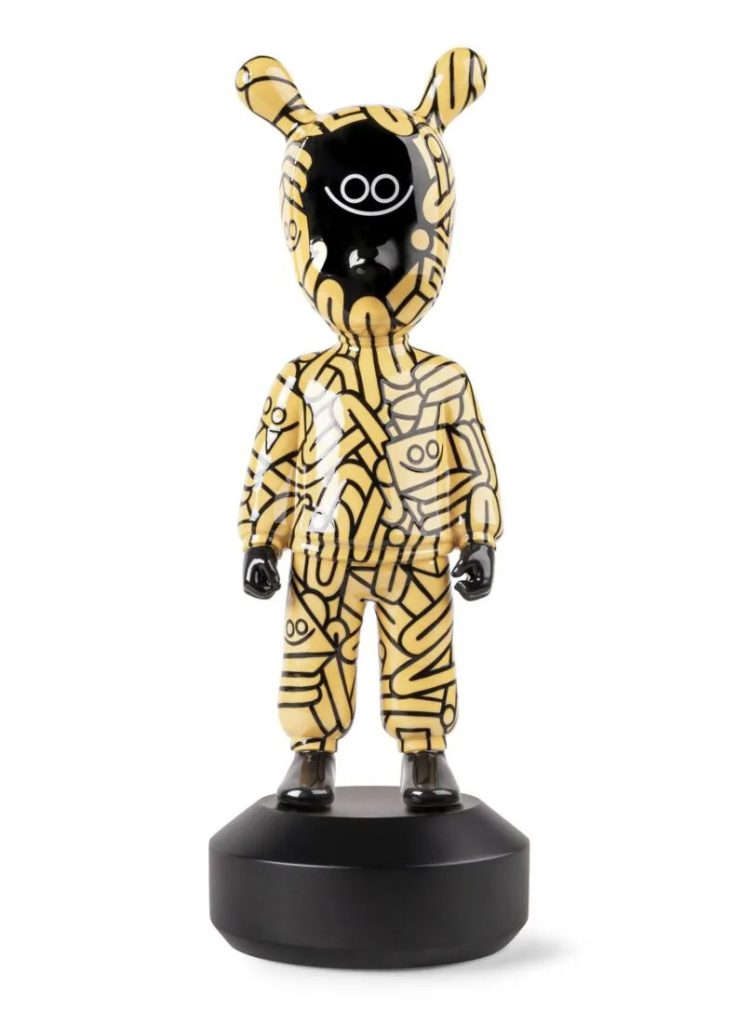
The Big Special Edition is something rarer still, a piece that carries the weight of exclusivity. Hand-decorated with a complex yellow-and-black pattern, it becomes an intricate three-dimensional labyrinth of design. Walking around this edition, one cannot help but feel as if the sculpture is alive—the patterns shift as the eye moves, inviting contemplation from every angle. It is not just a sculpture; it is a dialogue between the artist and the observer, a conversation rendered in porcelain. At $6,950, it is a commitment to rarity, craftsmanship, and the kind of joy that comes from owning something truly exceptional.
The Little Sculpture (Numbered Edition)

The Little Sculpture distills all of Díaz-Faes’ artistry into a more compact form. Its glazed black finish, punctuated by clean white patterns, captures the essence of the design in a way that feels intimate and personal. Small enough to sit on a desk or shelf, it still carries the presence and elegance of its larger siblings, offering collectors a versatile option. Priced at $1,250, it is a celebration of accessibility without compromise.
Geometry and Emotion: The Art of Juan Díaz-Faes
What fascinates me most about this Lladro iteration of The Guest is how geometry is transformed into emotional resonance. Díaz-Faes’ signature looping faces, angular yet fluid patterns, and hypnotic repetition are more than stylistic flourishes; they are conduits for human expression.
The figure’s curves and patterns invite reflection, almost meditative in effect. One cannot simply glance at it and move on—the eyes follow the loops, the mind tracks the rhythm, and suddenly, the sculpture has orchestrated a moment of presence. It is rare for a collectible porcelain piece to function almost like a silent companion, yet this is precisely what Díaz-Faes achieves.
In this sense, Lladro The Guest becomes a study of human connectivity. It reminds me of those quiet moments in life when observation alone can be meaningful—a pause, a gesture, a presence acknowledged without words. In the modern age, where immediacy often overwhelms, this sculpture is a quiet protest, an insistence on slowing down and paying attention.
Limited Edition as a Symbol of Artistic Commitment
There is something inherently poetic about the way Lladró approaches limited editions. By restricting the number of units, the maison elevates each piece beyond mere objecthood into collectible art. The exclusivity is not ostentation but reverence for craft, a recognition that the hand of the artisan imparts value that cannot be mass-produced.
I often think about this in the context of the Big Special Edition: only 30 units exist in the world. To hold one is to possess a piece of an artist’s vision that is almost sacred in its rarity. It is a reminder that luxury, at its finest, is not about extravagance alone, but about intimacy, storytelling, and connection between creator and collector.
The Emotional Journey of Collecting
There is a unique thrill in acquiring a piece like the new Lladro The Guest. It is not merely decorative; it is narrative. It carries the story of Díaz-Faes’ vision, the patience of the artisans, and the meticulous labor of hand-painted porcelain. Owning it is to enter into that story, to become part of a continuum where art, craft, and human emotion intersect.
I find myself imagining the moments this sculpture might witness: quiet mornings with sunlight spilling across its black-and-white lines, evening reflections on the curves of its form, the soft shadow play that turns a simple shelf into a stage for contemplation. In every angle, every glance, there is newness, and yet there is timelessness.
Porcelain as a Medium of Expression
Porcelain is both a blessing and a challenge. It demands precision, patience, and respect for its delicate nature. In Díaz-Faes’ work, it becomes a medium of storytelling, a surface on which geometric complexity and emotional depth coexist. Each brushstroke of black or yellow, each glaze and pattern, is an act of intention. Yes, a declaration that artistry is not simply seen but experienced.
This is why the Guest resonates so deeply with collectors and admirers alike. It is tangible proof that craft and concept can coexist in harmony, that geometric abstraction can carry warmth and intimacy, and that handwork remains an irreplaceable conduit for meaning.
A Modern Icon for Contemporary Spaces
The new Lladro The Guest is at once contemporary and timeless. Its bold geometric motifs would not feel out of place in a minimalist interior or a gallery, yet the warmth of the porcelain and the tactile detail keep it approachable. It is an object that sparks curiosity, invites touch, and encourages lingering observation.
For collectors, it represents a bridge between art and décor, between playful abstraction and traditional craftsmanship. It is the kind of piece that can anchor a collection, serving both as a focal point and as a conversational catalyst. Its presence in a home is never passive; it insists on engagement.
Conclusion: A Story in Porcelain
Ultimately, the new Lladro The Guest by Juan Díaz-Faes is more than a sculpture. It is a meditation on presence, a celebration of craft, and a testament to Lladró’s enduring dedication to storytelling through porcelain. Each edition—Big, Big Special, and Little—offers a different entry point into this narrative, yet all share a common language of elegance, precision, and emotional resonance.
Even as I write about it, I feel the rare combination of delight and contemplation that only truly masterful art can provoke. The loops, the curves, the hypnotic patterns draw the viewer in, but they do not overwhelm. They invite reflection, presence, and a recognition of the beauty that arises when craft, vision, and emotion converge.
The new The Guest is more than collectible; it is companionable. It reminds us that in a world of immediacy and disposability, patience, observation, and attention still yield immeasurable rewards. And perhaps that is the ultimate gift of this sculpture: it teaches us to slow down, to linger, and to find joy in the subtle poetry of form, color, and presence.
Featured images: Lladró

Amanda Akalonu is dedicated to weaving together the worlds of jewelry, watches, and objects through a lens of literary storytelling.