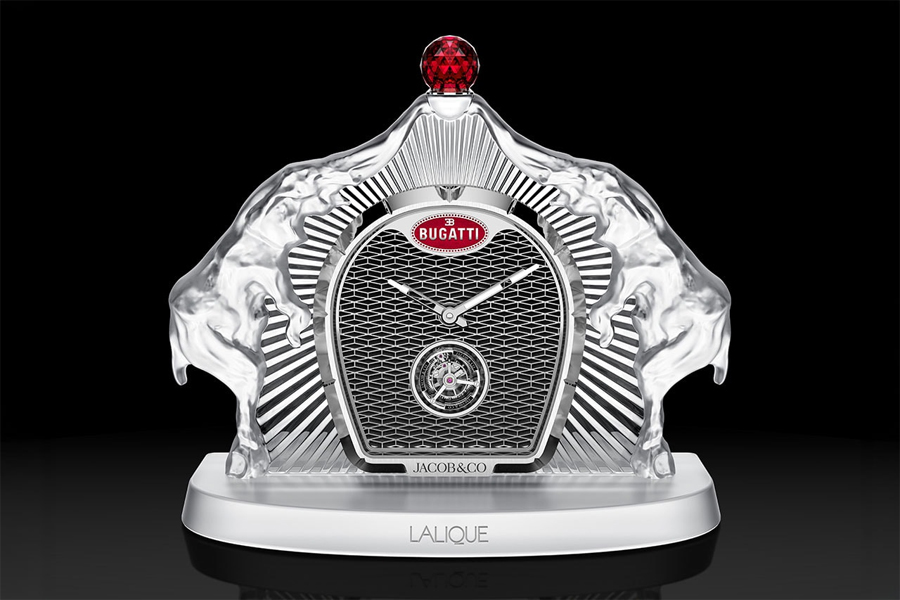

There are collaborations in luxury, and then there are true marriages of vision. These are projects so ambitious, so meticulously conceived, that they transcend the sum of their parts to become something entirely new. The Calandre Table Clock, unveiled in June 2025, represents exactly this kind of alchemy. Born from a three-year partnership between Jacob & Co., Bugatti, and French crystal master Lalique, this $240,000 timepiece reimagines what’s possible when watchmaking mastery collides with automotive heritage and crystalline artistry.
Standing 196mm tall and 264mm wide, the Calandre Table Clock is far more than an instrument for telling time. It’s a sculptural tribute to nearly a century of automotive legend, a technical showcase of advanced horology, and a masterpiece of French crystal craftsmanship all contained within a single, luminous creation that captures light and history in equal measure.
The Calandre Table Clock: A Legacy Written in Speed and Art
To understand the significance of the Calandre Table Clock, we need to journey back to the 1920s, when Ettore Bugatti conceived what would become perhaps the most legendary automobile ever created: the Type 41 Royale. Intended as the ultimate expression of automotive luxury, the Royale was designed for royalty. Literally. With a massive 12.7-liter straight-eight engine and a wheelbase longer than some contemporary cars are in their entirety, it represented Bugatti’s most ambitious vision.
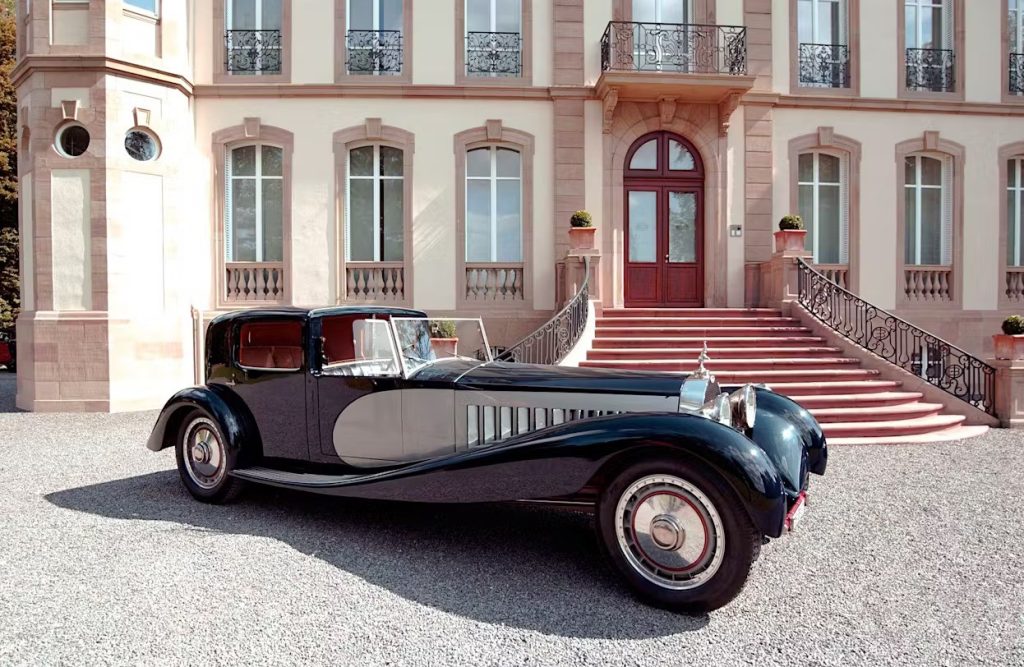
But what truly distinguished the Royale wasn’t merely its mechanical supremacy or princely proportions. It was the detail that crowned its elongated hood: a sculpture of a dancing elephant, created by Rembrandt Bugatti, Ettore’s younger brother and one of the most gifted sculptors of the early 20th century. That elephant—graceful, powerful, balanced on one leg in an impossible pose—became synonymous with Bugatti’s highest aspirations.
Only six Type 41 Royales were ever built between 1929 and 1933, with just three finding buyers due to the Great Depression. Today, those surviving examples rank among the most valuable automobiles ever created, regularly commanding prices above $10 million when they rarely change hands. The elephant mascot that adorned them has become one of the most recognizable symbols in automotive history.
The Calandre Table Clock brings that elephant back to life, not as mere decoration but as an integral element of a timepiece that honors everything the Royale represented.
The Art of Crystal and Time
At the heart of the Calandre Table Clock lies a creation that could only emerge from Lalique’s workshops in Wingen-sur-Moder, a small town in eastern France where the company has perfected crystal craftsmanship since 1922. The clock’s case isn’t simply made from crystal—it’s sculpted from it, with every curve and surface deliberately shaped to capture and refract light in specific ways.
The manufacturing process borders on the alchemical. Molten crystal reaches temperatures exceeding 1,400 degrees Celsius before being poured into precision-engineered steel molds. As the material cools and solidifies, it transforms from liquid fire into solid transparency, capturing the exact forms designed by the collaboration’s artists and engineers. But pouring is merely the beginning.
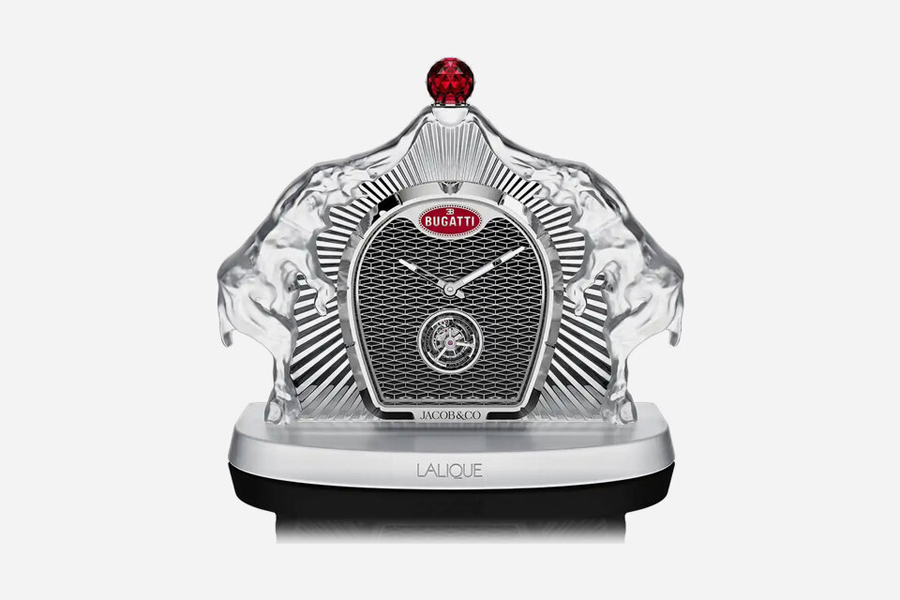
Lalique’s master artisans then spend months—not days or weeks, but months—refining every surface of each Calandre Table Clock (it’s limited to 99 pieces). They sharpen edges to razor precision, enhance textures to create deliberate contrasts between frosted and polished finishes, and ensure that when light passes through the crystal, it illuminates and accentuates every sculptural detail. The frosted surfaces scatter light softly, creating gentle halos and shadows, while the polished areas channel it into focused beams and reflections.
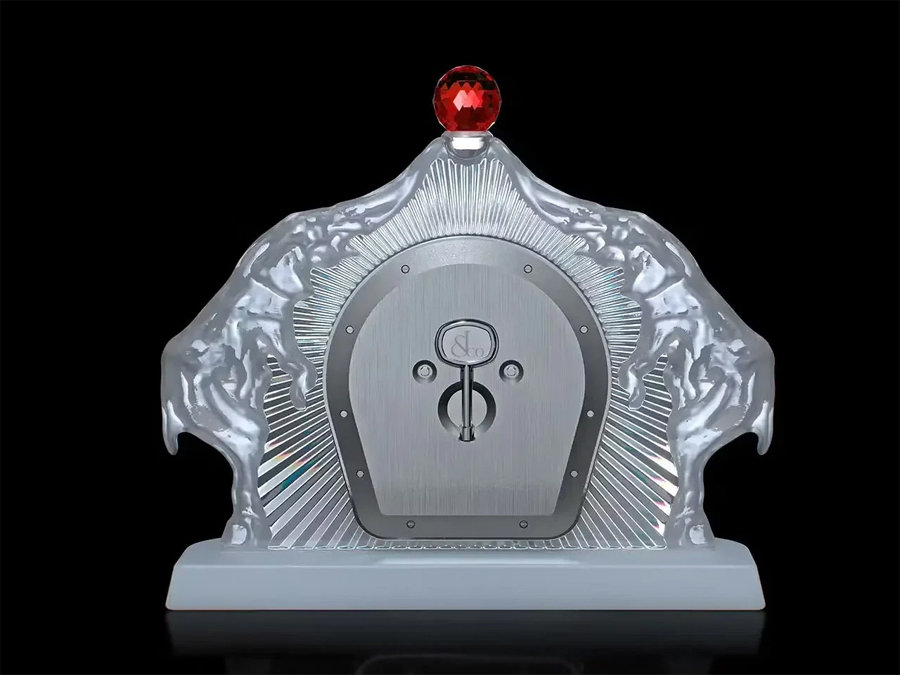
Flanking the clock’s central horseshoe grille are two Dancing Elephants, sculpted in Lalique crystal using the same lost-wax casting technique employed for the original Rembrandt Bugatti sculpture nearly a century ago. These aren’t simplified representations but faithful recreations, capturing every nuance of the original work. The elephants lean gracefully toward each other in a symmetrical pose that defined numerous Lalique clock designs throughout the 20th century. Yes, this is a deliberate nod to the historical relationship between these two French luxury houses.
The Technical Heart: A Tourbillon with Purpose
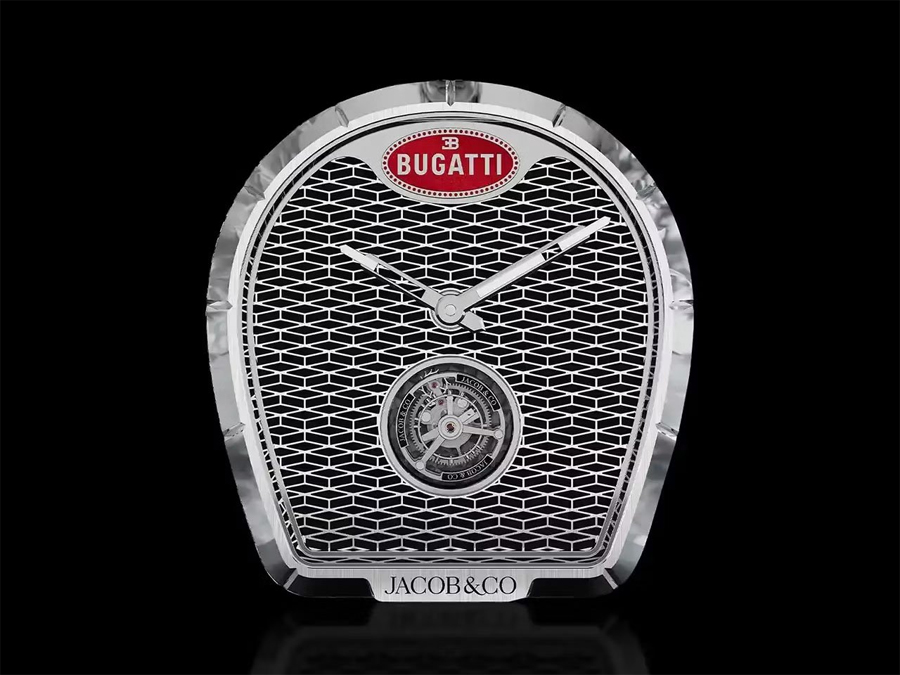
Behind the clock’s horseshoe grille, that unmistakable Bugatti design element that has defined the brand’s automobiles since the beginning, sits the JCAM58 movement, a 189-component caliber developed specifically for the Calandre Table Clock. This wasn’t an adaptation of an existing movement or a modified pocket watch mechanism. Jacob & Co.’s engineers designed it from scratch around a single, crucial complication: the vertical flying tourbillon.
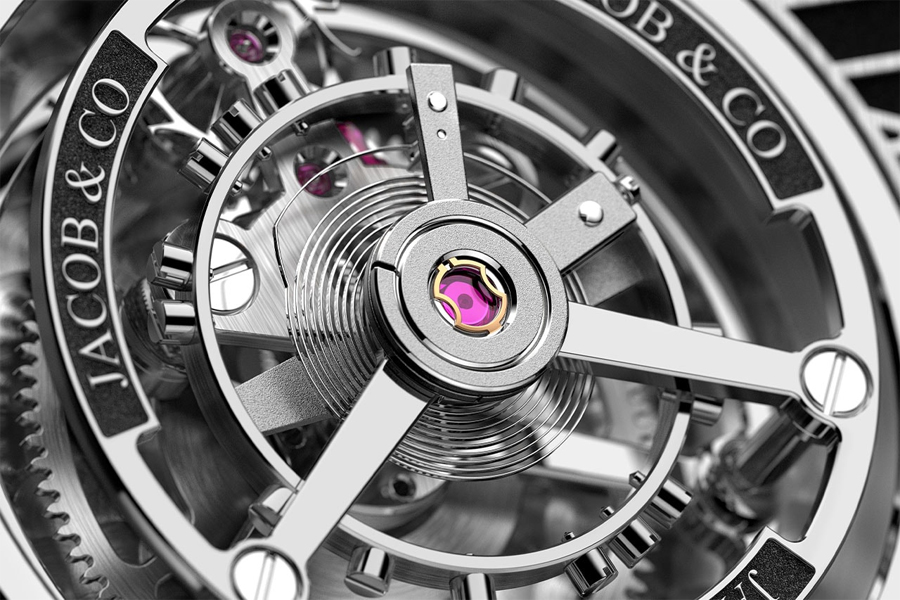
For those unfamiliar with haute horological complications, a tourbillon is a mechanism originally invented by Abraham-Louis Breguet in 1795 to improve timekeeping accuracy. It places the escapement and balance wheel inside a rotating cage that completes one full revolution per minute (in traditional configurations), theoretically counteracting the effects of gravity on these delicate components. In pocket watches, which spent most of their time in vertical positions, tourbillons measurably improved accuracy.
In modern wristwatches, tourbillons have become more about showcasing mechanical artistry than practical necessity, since wrists constantly change position throughout the day. But in a table clock—a timepiece designed to remain in a fixed, vertical position for extended periods—the tourbillon returns to its original purpose. The Calandre Table Clock’s vertical flying tourbillon (so-called because it’s mounted without an upper bridge, appearing to “fly” within the movement) genuinely enhances timekeeping precision while simultaneously serving as the clock’s visual centerpiece.
The movement delivers an eight-day power reserve, meaning a full manual winding provides 192 hours of operation before requiring attention. This extended reserve is crucial for a desk clock, allowing it to run through an entire week plus an extra workday without intervention. To maintain the clock’s aesthetic purity, both time-setting and winding are performed using a special key inserted into the caseback, eliminating any protruding crowns or pushers that would compromise the design’s clean lines.
A Crown of Fire
Perched atop the Calandre Table Clock like a crown sits perhaps its most striking single element: a 30mm red gemstone, cut using Jacob & Co.’s proprietary “Jacob cut.” This substantial stone isn’t merely decorative. It serves as a deliberate color callback to the red Bugatti Macaron, that iconic oval badge that has identified every Bugatti automobile since Ettore’s earliest creations.
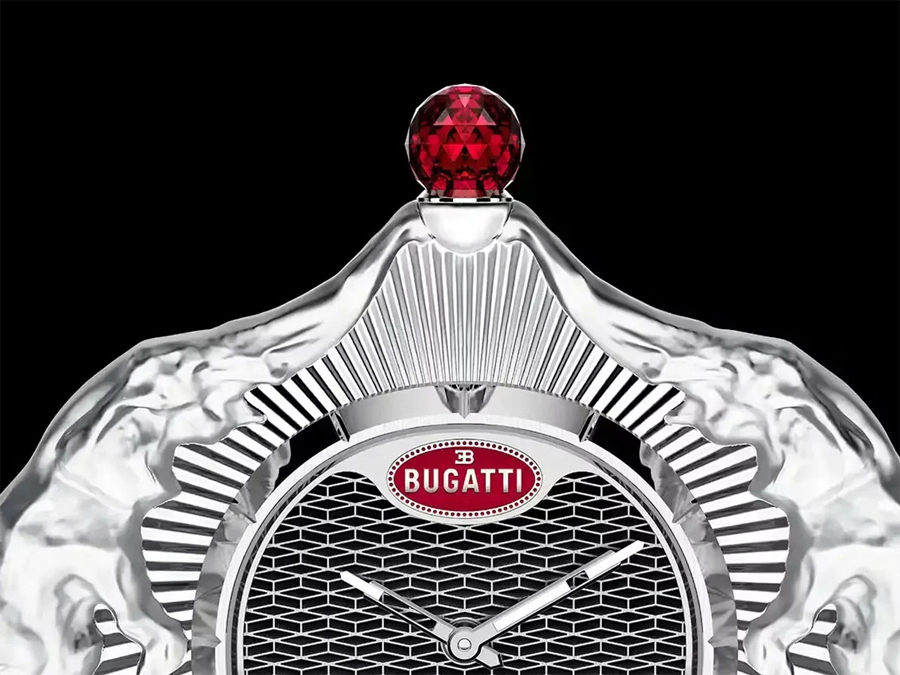
The choice of a red gemstone adds another layer of meaning. In horological tradition, gemstones have long been used to denote complications and special features. Here, the crimson stone acts as a beacon, drawing the eye upward and establishing a visual hierarchy that moves from the crystal elephants through the horseshoe grille and tourbillon, culminating in this glowing capstone.
The size and cut of this gem required considerable expertise to execute. At 30mm, it’s substantial enough to serve as the clock’s visual apex, yet proportioned to avoid overwhelming the overall composition. The Jacob cut—a proprietary technique developed by the company for its high jewelry pieces—maximizes the stone’s fire and brilliance, ensuring it captures and reflects light with exceptional intensity.
Limited to the Few
With only 99 pieces planned for production and a price of $240,000, the Calandre Table Clock occupies a rarefied space in the luxury market. This isn’t a timepiece for casual collectors or those seeking simple prestige. It’s designed for the Venn diagram intersection of haute horlogerie connoisseurs, Bugatti enthusiasts, and collectors of exceptional French decorative arts—a group that’s admittedly small but passionately dedicated to objects of transcendent quality.
Each clock arrives in a bespoke tan leather trunk reminiscent of the luxury luggage that would have accompanied Type 41 Royale owners on their grand tours. This isn’t merely packaging. It’s an integral part of the ownership experience, evoking the golden age of automotive travel when automobiles were as much about the journey’s style as the destination’s arrival.
The presentation also includes documentation certifying the clock’s authenticity and its number within the limited edition, signed by representatives from all three participating houses. For serious collectors, this provenance is as important as the object itself, establishing the piece’s place in the continuum of luxury craftsmanship.
More Than Timekeeping
Standing before the Calandre Table Clock (and I use “standing” deliberately, as this is a piece that commands physical presence and demands to be experienced in three dimensions), you’re struck by how it transcends its ostensible function. Yes, it tells time with exceptional precision thanks to its flying tourbillon. But that’s almost beside the point.
This is an object designed to inspire contemplation, to spark conversation, to serve as a daily reminder of what human creativity can achieve when vision, skill, and resources align without compromise. It’s a sculpture that happens to keep time, a tribute to automotive history that happens to be horological, a crystal artwork that happens to house mechanical complication.
Featured images: Jacob & Co.

Amanda Akalonu is dedicated to weaving together the worlds of jewelry, watches, and objects through a lens of literary storytelling.