
There is something rather wonderful about an object that does far more than it needs to. A cigarette case could simply hold cigarettes. A vanity case could keep lipstick and powder in order. A photograph frame could stand on a desk, doing its quiet work of holding a picture in place. But imagine these objects carved from agate, decorated with mother-of-pearl flowers, enlivened with enamel, and finished with diamonds. Suddenly, their everyday purpose becomes almost incidental. What remains is the pleasure of looking at them, the ingenuity of their construction, and the knowledge that someone once considered even the smallest rituals of daily life worthy of exceptional craftsmanship.
That is the world opened up by Sotheby’s Extraordinary Objects by Boucheron, a collection of more than 40 pieces from a European family, spanning the French maison’s creations from the late nineteenth century into the twentieth. Offered in Paris on October 8, 2026, the collection brought together a remarkable assortment of boxes, vanity accessories, cigarette cases, and other objects that sit at the intersection of jewelry, sculpture, and the decorative arts.
For those accustomed to thinking of Boucheron through its high jewelry, the sale offered another way into the house’s creative history. These were not necklaces or bracelets designed to adorn the body. They were objects intended to be handled, opened, carried, placed on a dressing table, or displayed on a desk. And yet, many possessed the same qualities that make an exceptional jewel compelling: unusual materials, intricate workmanship, a strong sense of design, and a willingness to make the ordinary extraordinary.
The question is whether the response to these objects points to a renewed appetite for such pieces—or whether collectors are simply becoming more selective about what deserves a place in their collections. The auction offers some intriguing clues.
The Boucheron Sale: When Objects Become the Attraction
The appeal of Boucheron’s archival objects begins with a simple observation: they were never treated as mere containers. Consider the house’s early twentieth-century vanity accessories. Their purpose was practical enough, but their makers approached them with an attention to detail more commonly associated with miniature works of art.
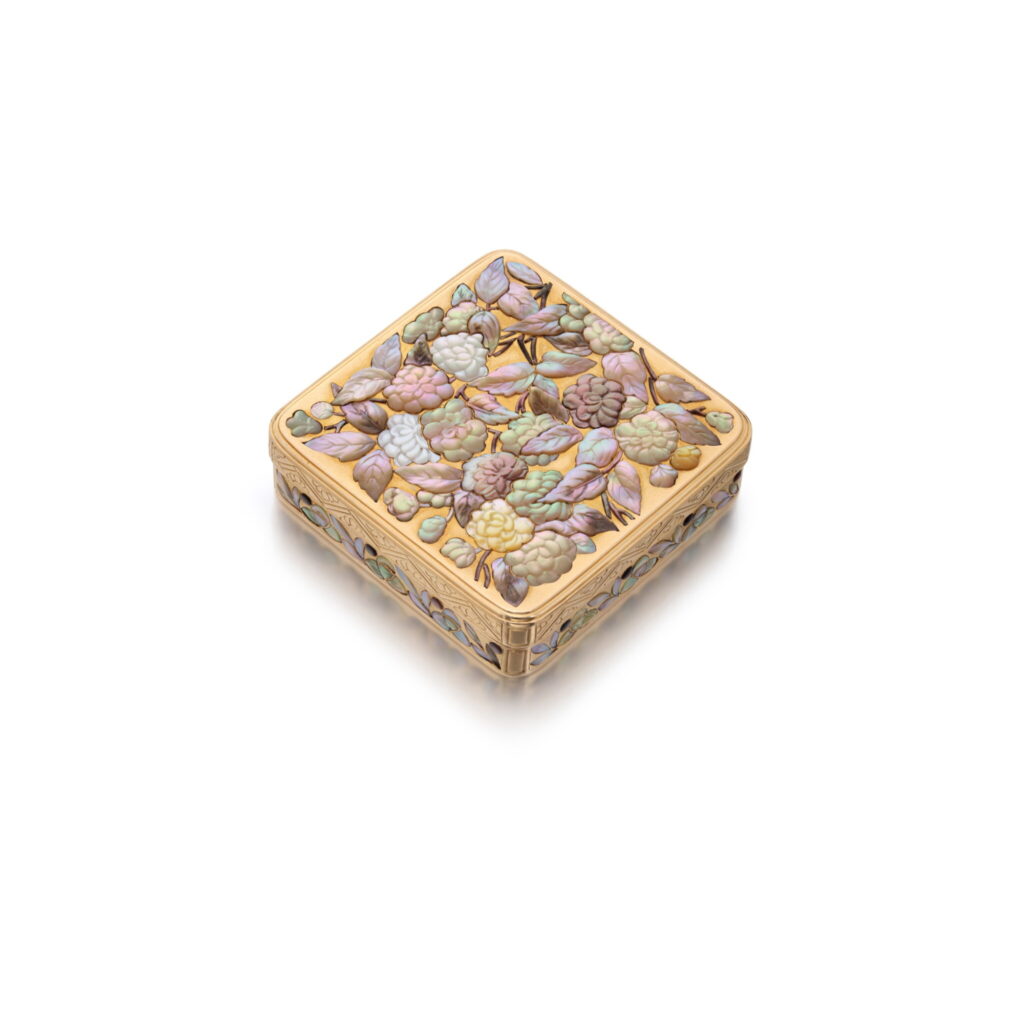
A 1920s vanity case in the sale, for example, was decorated with carved mother-of-pearl flowers and leaves. Open the lid, and the object revealed a lipstick holder, a powder compartment, and a mirror. The exterior was not simply a decorative skin wrapped around a functional interior. The ornament and the mechanism belonged to the same design, each contributing to the experience of using it.
Another vanity case, dating to the 1920s, combined grey and white enamel with a polychrome floral motif and rose-cut diamonds. Its octagonal form opened to reveal a hinged mirror and three compartments, while a chain set with seed pearls completed the composition.
There is a certain intimacy to these objects. Unlike a jewel worn to announce an occasion, a vanity case might be opened in front of a mirror, in the middle of an ordinary afternoon. Its beauty was encountered at close range, sometimes by its owner alone. That intimacy is part of what makes the pieces so appealing today. They offer a glimpse of a time when the smallest personal accessories could be designed with extraordinary care.
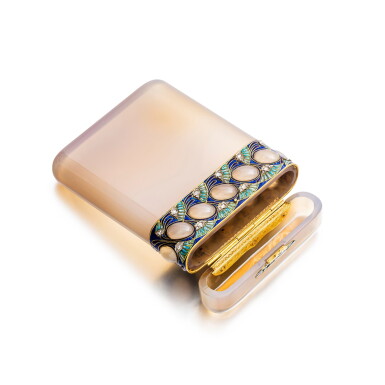
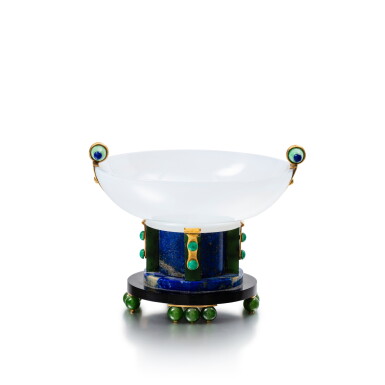
The same sensibility appears in the collection’s cigarette cases. One was carved from pale grey agate, with blue and green enamel papyrus flowers, agate cabochons, and rose-cut diamonds. Another combined black enamel with mother-of-pearl floral medallions, onyx, lapis lazuli, and diamonds.
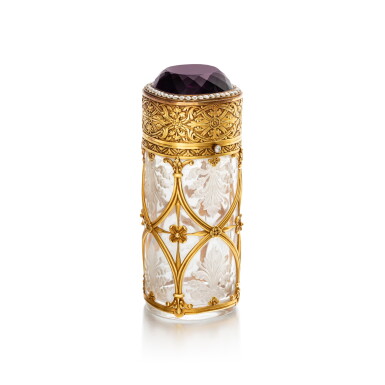
The materials were not chosen merely to make these Boucheron objects expensive. They created contrasts of color, texture, and light. The cool, slightly cloudy surface of agate offered a different experience from the sheen of enamel; mother-of-pearl brought an iridescence that changed with the angle of the light. The result was something more considered than a luxury version of an everyday accessory. Each object had its own visual character, almost like a small composition intended to be held in the hand.
A Cigarette Case That Sold for More Than Twice Its High Estimate
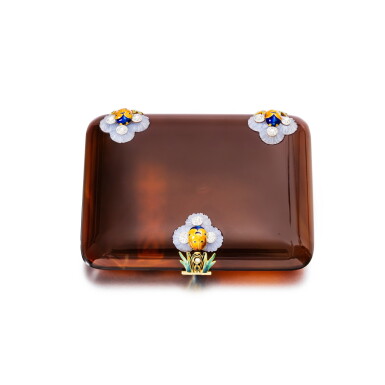
The market response to some of these pieces was particularly striking. A Boucheron cigarette case from the 1920s, carved from pale grey agate and decorated with enamel papyrus flowers, agate cabochons, and rose-cut diamonds, carried an estimate of €17,000–€26,000. It sold for €40,960, well above the upper end of its estimate. Another cigarette case, this one in sardonyx with chalcedony flowers, enamel ladybugs, and rose-cut diamonds, achieved €51,200 against an estimate of €14,000–€22,000.
The second piece is particularly revealing in its use of detail. Its rectangular sardonyx body provides a dark, restrained ground for the decorative elements. The ladybugs, placed on the clasp and hinges, introduce a note of playfulness, while the chalcedony flowers and diamonds bring delicacy and sparkle. It is an unusual combination: a relatively sober stone, a whimsical natural motif, and the kind of precise decorative work that rewards a closer look.
That contrast is part of the pleasure. The case does not rely on a single spectacular gemstone or an imposing display of diamonds. Its appeal lies in the relationship between its materials and the small surprises built into its design.
The sale also included a 1930s agate box with emeralds and rose-cut diamonds that sold for €30,720, against an estimate of €7,000–€10,000. Together, these results suggest that certain collectors were prepared to bid decisively for objects whose appeal extended beyond their materials to encompass their design and craftsmanship. They do not, on their own, establish a market-wide trend. But they do make a persuasive case for looking more closely at the category.
The Extraordinary Art of the Miniature
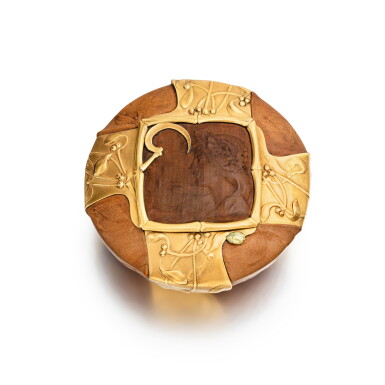
One of the most intriguing objects in the collection was a Boucheron wooden bonbonnière, or small decorative box, carved from boxwood and pearwood. The lid depicted a druidess crowned with mistletoe and holding a sickle. Gold plaques engraved with mistletoe branches enhanced the design, while the push-button was fashioned as an enamelled ladybird. The piece belonged to the Art Nouveau period and was associated with the sculptor Edmond-Henri Becker, whose work crossed the boundaries of sculpture, goldsmithing, and the decorative arts.
It is an object that rewards a little imagination. The box is small enough to be held in the hand, yet its decoration suggests an entire world: botanical symbolism, a figure drawn from an older visual vocabulary, the texture of carved wood, and a tiny insect transformed into a functional detail.
Even the choice of material is telling. Wood brings a warmth and tactility that would be difficult to achieve with gold alone. Rather than concealing the material beneath a surface of precious stones, the design allows the wood to become part of the story.
This is where the category becomes especially interesting for collectors. The value of an object like this cannot be understood simply by weighing its gold or counting its gemstones. Its appeal also rests on the originality of the design, the quality of the carving, the historical context, and the survival of an unusual piece of craftsmanship.
In other words, it asks us to look at the object as a whole. That is not to suggest that materials and preciousness cease to matter. Rather, they become part of a larger equation, one in which the designer’s imagination and the object’s individuality carry considerable weight.
A Gold Photograph Frame, and the Pleasure of Display
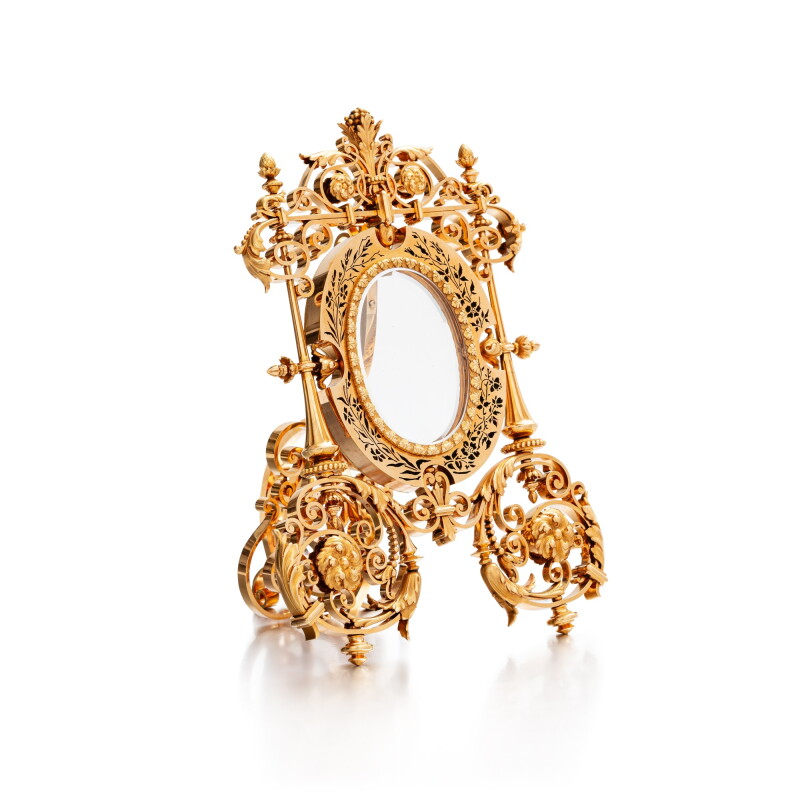
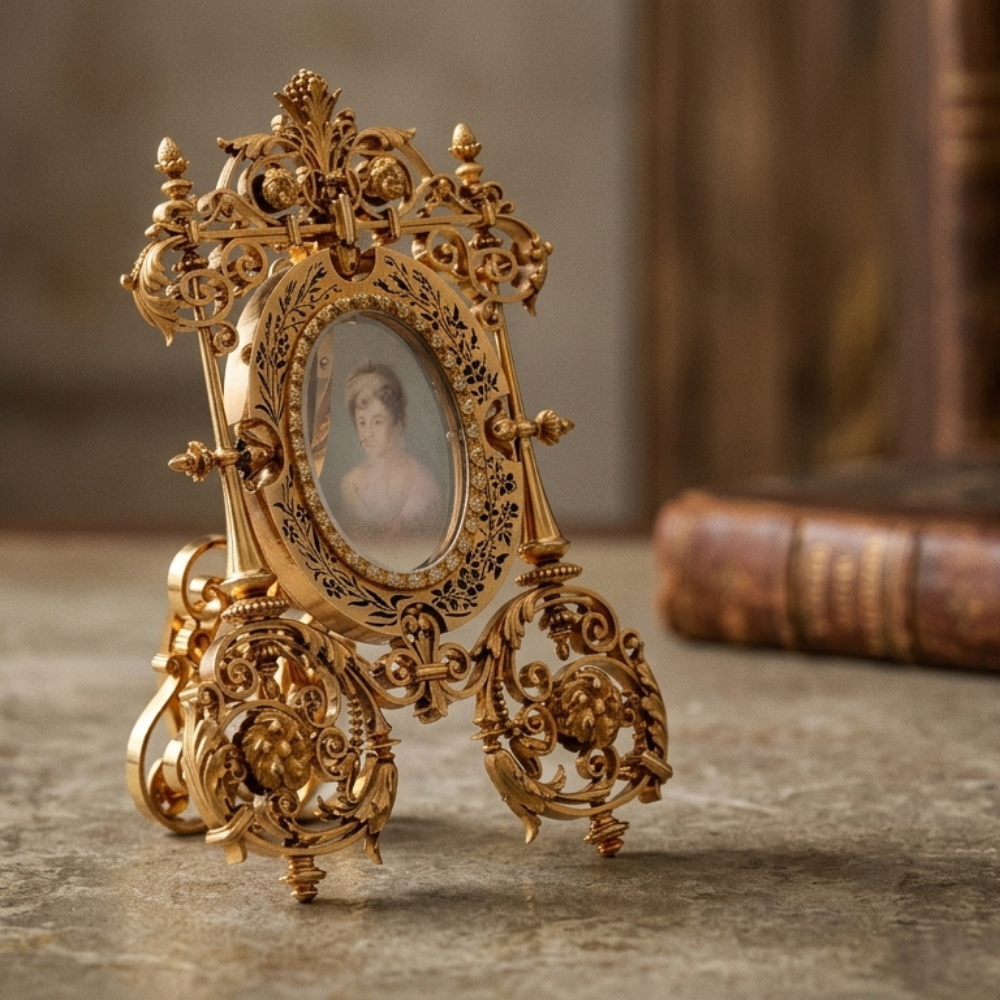
Perhaps the clearest example of this broader approach to collecting was a Boucheron gold photograph frame from the 1880s. Designed by J. Début and executed by Menu, the frame took the form of a three-legged easel, decorated with scroll motifs and chased foliage. It was a relatively small object, measuring approximately 16 by 10 centimeters, but it was made with the care one might expect from a much more conspicuous piece of jewelry.
Its auction result was notable. Against an estimate of €22,000–€30,000, the frame sold for €70,400. That is more than twice its high estimate.
The result is interesting precisely because a photograph frame is such a familiar object. We tend to think of frames as supporting players: their purpose is to draw attention to the photograph, not to themselves. Here, the relationship is reversed. The frame has enough sculptural presence to become an object of interest in its own right.
Its form also speaks to a different way of living with beautiful things. This is not an accessory that disappears into a handbag or a drawer. It is designed to be seen, placed on a desk or dressing table, where its chased ornament and gold surface can be appreciated throughout the day. The photograph it holds may be deeply personal, but the frame has a life of its own.
For collectors drawn to objects that bring art into everyday surroundings, that combination is especially appealing. A photograph frame, a small box, or a decorative clock can occupy a space between the intimate and the public. It belongs to a home, but it also reveals something about the person who chose it.
When Timekeeping Becomes Sculpture
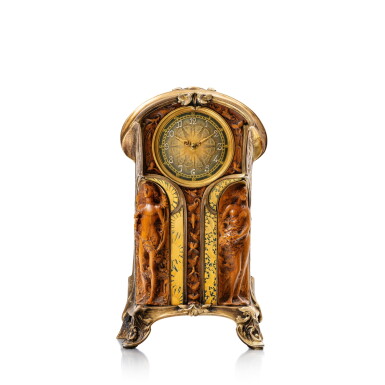
The collection’s sculptural desk clock offered another expression of Boucheron’s interest in objects that could function as miniature theatrical scenes.
Dating to the early twentieth century, the clock combined an enamel dial with carved boxwood niches representing Day and Night in the guise of Apollo and Artemis. Above them stood an allegorical figure of Time wielding a scythe. Carved wood and chased vermeil, or gilded silver, completed the composition.
The piece was estimated at €44,000–€55,000. Its catalogue history also connected it to Edmond-Henri Becker, whose practice encompassed sculpture, engraving, and the decorative arts.
It is difficult to imagine a more elaborate way of presenting the time. Rather than treating the clock as a dial and mechanism housed inside a case, the design gives time a cast of characters. Day and Night become figures. Time itself takes on a human form. The clock is both a functional object and a sculptural arrangement, inviting the eye to travel around its composition before settling on the hour.
This kind of design belongs to a period when the boundaries between jewelry, sculpture, and the decorative arts were often more fluid than modern categories suggest. A jewelry house could draw on the skills of sculptors, engravers, enamellers, and specialist workshops to create objects that resisted easy classification. That collaborative dimension is worth remembering. A signed Boucheron object does not necessarily mean that every part was made by a single hand within the maison. The catalogue’s references to designers, makers, and specialist workshops help illuminate the network of expertise behind these creations.
For a collector, that information adds another layer to the object’s story.
What the Results Tell Us—and What They Don’t
It is tempting to look at the strongest results from a sale like this and conclude that collectors are rediscovering decorative objects. There is a compelling argument for that interpretation. In a world increasingly dominated by streamlined products and digital convenience, objects that invite physical interaction and close attention can feel unusually satisfying. But auction results are rarely so simple.
The pieces in Sotheby’s sale differed in age, material, design, condition, and estimate. A distinctive object with a strong visual identity may attract competition for reasons that do not apply to another piece from the same house. Provenance, rarity, and the availability of comparable examples can all influence bidding.
The results are therefore best read as a series of individual signals rather than proof of a sweeping change in taste.
Still, there is something worth paying attention to here. Several of the strongest-performing objects were not large jewels built around exceptional center stones. They were smaller, highly individual creations whose appeal lay in the relationship between materials, workmanship, and design.
The gold photograph frame, the agate cigarette cases, and the emerald-set box each offered something distinct. They were recognizable as Boucheron, but they were not interchangeable expressions of a house style. Each had its own character. For collectors, that distinction matters. The most interesting acquisition is not always the most obvious one. Sometimes it is the object that reveals a less familiar side of a celebrated maker, or one that brings a forgotten craft into focus.
And for those interested in Boucheron’s history, these pieces offer a reminder that the maison’s creative identity extends well beyond the jewelry worn on the body. Its archives also contain a world of personal accessories and decorative objects in which technical virtuosity meets a playful, sometimes eccentric imagination.
Beyond the Jewel
The most compelling thing about Extraordinary Objects by Boucheron may be the way it expands our idea of what a luxury collectible can be. A cigarette case, a vanity box, a photograph frame, or a clock might once have been part of the daily rhythm of someone’s life. Today, these objects can be approached as historical artifacts, examples of specialist craftsmanship, or small works of art that happen to retain their original functions.
Their appeal does not depend entirely on nostalgia for a more ceremonious age. It lies in the fact that they were made with a level of attention that is increasingly unusual—and that their designs remain capable of surprising us.
The auction does not prove that collectors are turning away from conventional jewelry in favor of decorative objects. It does, however, offer a persuasive reminder that the world of collecting is wider than the most familiar categories suggest. Sometimes the most revealing pieces are not the ones intended to be worn, but the ones designed to be opened, held, displayed, and lived with.
And sometimes, a little box is never just a box.
All images courtesy of Sotheby’s

Sewelo is a world where jewelry, watches, and objects come alive in a shimmering dance of fantasy. Through a literary lens, we celebrate the beauty and elegance that make these treasures more than just possessions.