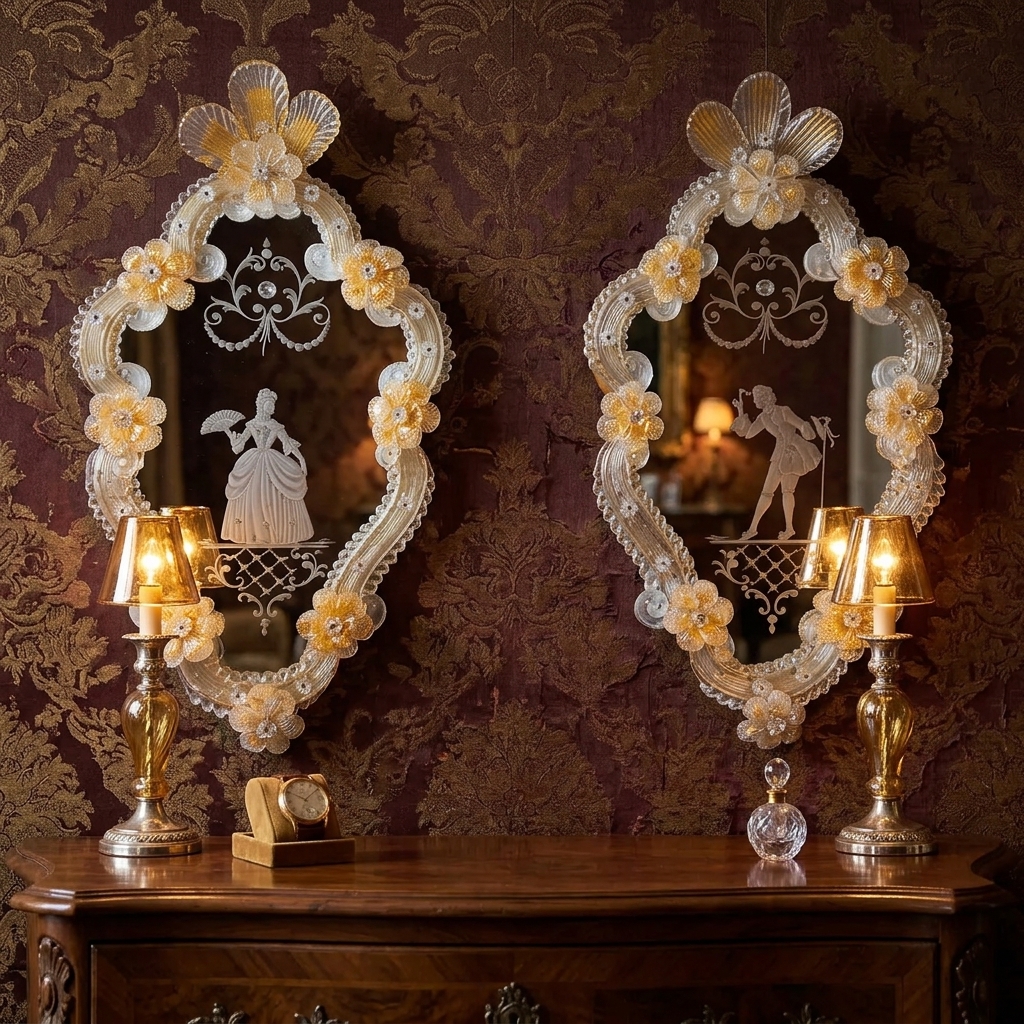

There is a moment when you stand before a genuine antique Venetian mirror, when the room behind you seems to become a better version of itself. The reflection is not sharp and cold the way a modern mirror’s is. It is soft, slightly luminous, with a warmth that silvered glass simply cannot replicate. The frame around it is not wood dressed up to look decorative; it is itself made of glass, hand-cut and hand-beveled, set with glass rosettes and hand-crimped foliage, assembled by craftspeople whose techniques were considered so valuable that the Venetian Republic once threatened death to anyone who exported them. Standing in front of a Venetian mirror is not merely an aesthetic experience. It is a confrontation with several centuries of extraordinary human ingenuity, and one of the most compelling collecting propositions the decorative arts world has to offer.
Venetian mirrors have been the most coveted reflective objects in the world since the sixteenth century, when Murano glassmakers discovered how to back clear glass with a mercury-tin amalgam that produced a quality of reflection so luminous it made other mirrors look like puddles. At their peak, these objects were worth more than oil paintings, more than naval warships, and more than most of the furniture in the rooms they adorned. The secrets of their manufacture were guarded with a ferocity that would be impressive even by modern corporate espionage standards. And yet, despite everything—the French industrial theft of the seventeenth century, two world wars, the mass-production era, the rise of machine-cut glass—the finest antique Venetian mirrors remain among the most sought-after objects in the collector market, prized by serious decorators and connoisseurs of beautiful things worldwide. Here is everything you need to know about them.
The Renaissance Breakthrough: How Venice Created European Luxury
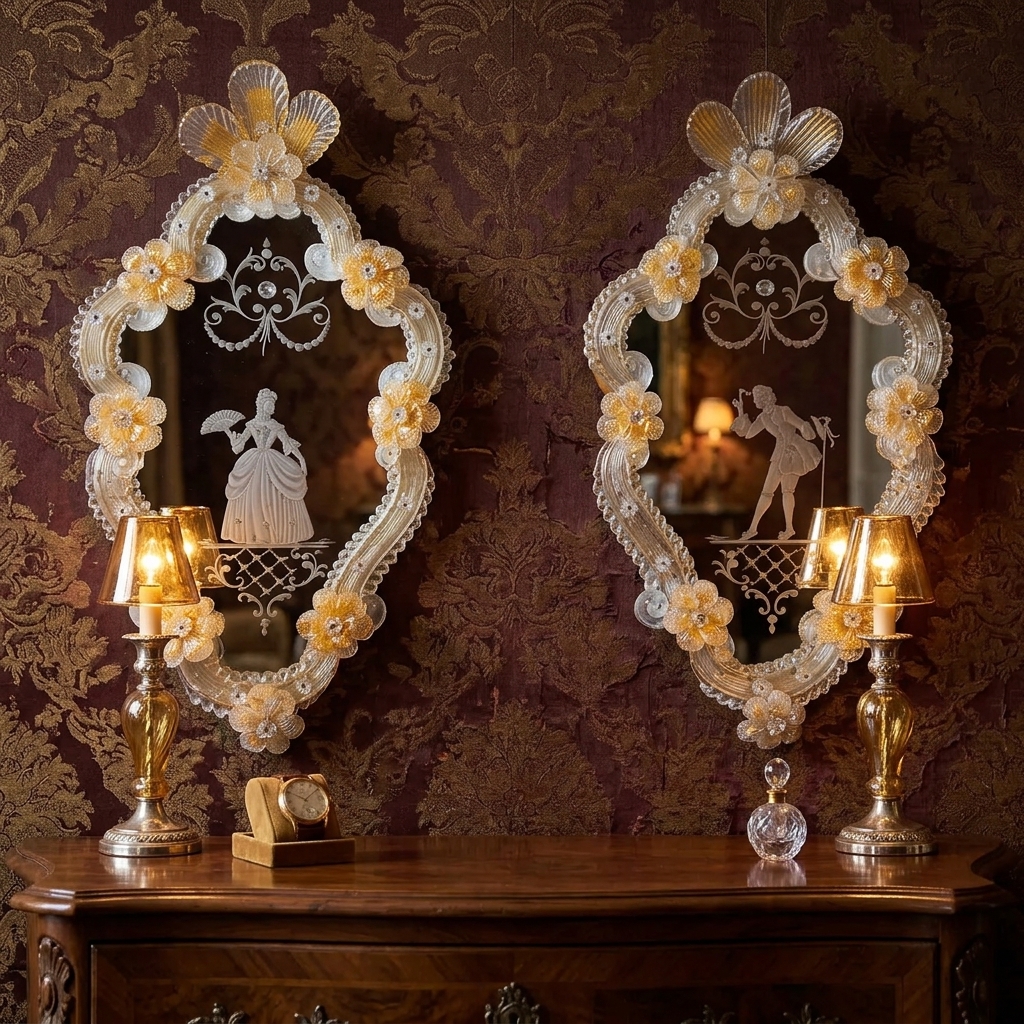
The story of Venetian mirrors begins not with mirrors at all but with glass, specifically, with the invention of cristallo by the Murano master Angelo Barovier in the fifteenth century. Cristallo was something genuinely new: a clear, virtually colorless glass of a purity that no European workshop had previously achieved. Before Barovier’s discovery, glass was invariably tinted (green, brown, or amber) by the iron and manganese impurities in the raw materials. Cristallo eliminated those impurities through a combination of refined materials and a manganese-based decolorizing process, producing glass so transparent that, for the first time, a truly reflective mirror plate became possible.
The Murano monopoly that made this possible had been established in 1291, when the Serenissima Republic ordered all glassmakers on the Venetian mainland to relocate to the island of Murano—ostensibly for fire safety reasons, though the real motivation was containment. On Murano, the glassmakers could be watched, their movements controlled, their techniques kept inside walls that the Republic could monitor. The master glassmakers were granted extraordinary privileges, such as the right to wear swords, to intermarry with Venetian noble families, but they were, in a meaningful sense, gilded prisoners. The penalty for sharing the secrets of Murano with outsiders was death, a policy the Republic enforced with the kind of seriousness that tends to concentrate the mind.
The mercury-tin mirror came early in the sixteenth century. The technique involved pouring liquid mercury over a sheet of tin foil laid on a flat surface, then carefully lowering the glass plate onto the amalgam and applying weight to press the backing evenly against the glass. The result, once the excess mercury was drained away and the backing set, was a mirror of a quality Europe had never seen. It was soft, luminous, with a slightly warm grey tonality that gave reflections a depth and intimacy entirely absent from polished metal mirrors. Venetian mirrors made with mercury-tin backing were extraordinary objects, and they were priced accordingly. At their peak, a large Venetian mirror could cost more than an Old Master painting of comparable size. The Duke of Northumberland reportedly paid more for a Venetian mirror than for the Raphael hanging beside it.
The French heist of 1665 is one of the more dramatic episodes in the history of industrial espionage. Louis XIV’s chief minister Jean-Baptiste Colbert, determined to build the Hall of Mirrors at Versailles and equally determined not to pay Venetian prices for the glass, dispatched agents to Murano to recruit master glassmakers with offers of extraordinary wages and royal protection. Several masters made the journey to France, where they established the Manufacture Royale des Glaces de France, breaking the Venetian monopoly that had held for nearly two centuries. The Republic of Venice sent assassins after the defectors. Whether they succeeded in any cases is a matter of historical debate. What is certain is that the monopoly was broken, the Hall of Mirrors was built, and Venetian mirrors—while never losing their prestige—entered a new competitive era.
Anatomy of a Masterpiece: What Defines an Authentic Venetian Mirror
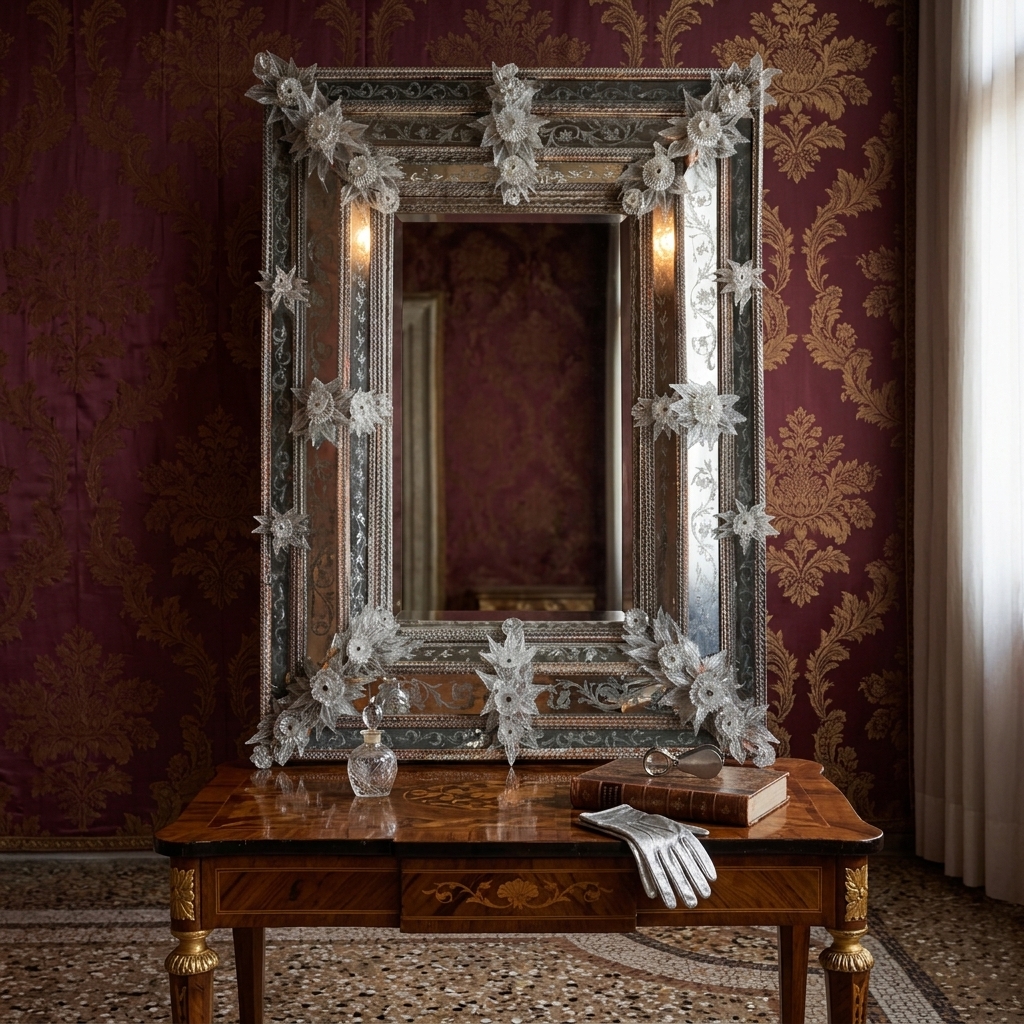
Understanding what goes into the making of an authentic Venetian mirror is essential for any collector, because it is precisely these construction details that separate genuine period pieces from the reproductions that flood the market.
The most fundamental distinction is the frame construction. Unlike giltwood or carved wood mirrors (in which a single large glass plate is set into a decorative wooden surround), Venetian mirrors are built from glass throughout. The frame itself is assembled from multiple hand-cut, hand-beveled glass segments arranged around a central mirror plate. These segments are typically engraved, etched, or otherwise decorated, and they are secured to each other and to the frame structure using glass rosettes—small blown glass flowers, often in clear or colored glass—and hand-crimped glass foliage elements. The result is an object of extraordinary visual complexity in which every element, including the structural components, is itself a work of craft.
Wheel-engraved reverse glass work is one of the most technically demanding elements of the finest Venetian mirrors. In this technique, motifs, such as cherubs, mythological figures, floral vines, and birds, are hand-carved onto the back surface of the glass segments, so that they appear in relief when viewed from the front. The carving is done on the reverse face, meaning the engraver works as if writing in a mirror, which requires both extraordinary skill and the ability to think spatially in reverse. The quality of this engraving is one of the clearest indicators of a piece’s age and authenticity.
Avventurina and lattimo accents provide two additional layers of material sophistication. Avventurina is glass embedded with tiny copper crystals that produce a golden, glittering effect when the glass is viewed in light. This is a technique developed on Murano and is impossible to replicate by mechanical means. Lattimo is an opaque, milky-white glass made by adding tin oxide, used in decorative canes integrated into frame borders. The presence of these materials in a frame, properly executed, is a strong indicator of genuine Murano manufacture.
Essential Eras and Styles for Modern Collectors
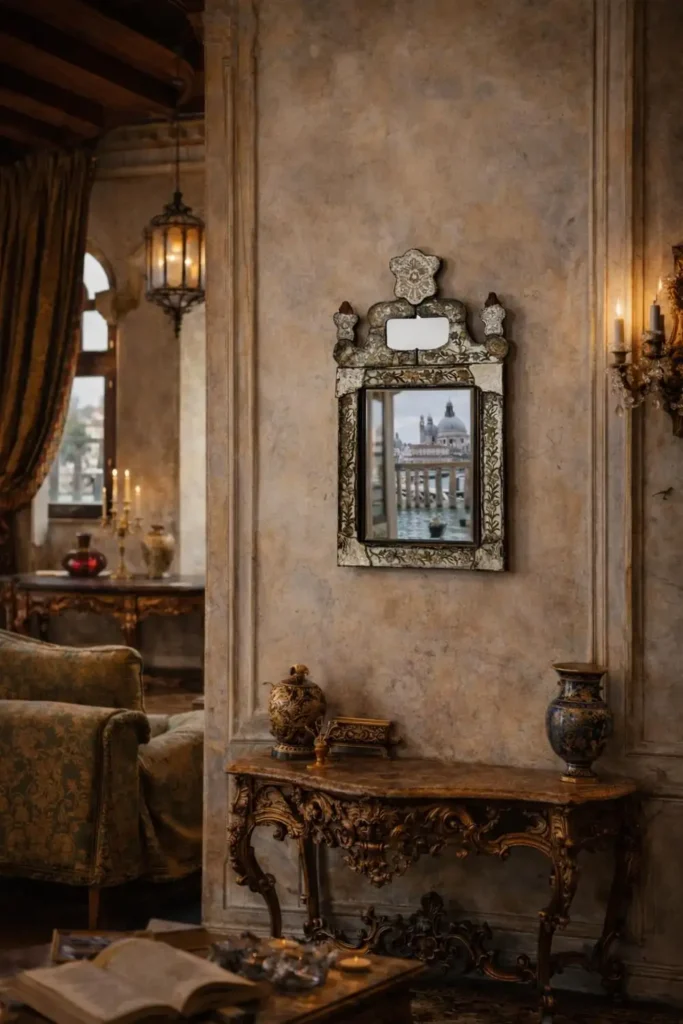
The antique Venetian mirror market spans several distinct collecting eras, each with its own aesthetic character, value profile, and collector demand.
17th and 18th Century Baroque and Rococo pieces represent the summit of the collecting hierarchy. These are the mirrors of the grand tour era. These are the objects that appeared in the inventories of Medici palaces and English country houses, and were listed in wills alongside jewels and silver plate. Signature characteristics include elaborate crests (called cimasa) in elaborately scrolled glass, deeply beveled cushion frames, and—most importantly—mercury-tin backings that produce the characteristic soft grey patina that authenticates age. The foxing pattern on genuine mercury-backed glass is organic and irregular, concentrated toward the edges where mercury degradation first occurs. This cannot be convincingly faked by spraying dots of black paint, though that does not stop reproductions from trying. These pieces carry the highest museum value and command the strongest auction prices.
19th Century Neoclassical Revival mirrors represent a more accessible collecting tier without sacrificing authentic period quality. The Neoclassical turn brought symmetrical profiles, delicate floral scrolls, and acid-etched classical figures to Venetian mirror design. It’s a cooler, more restrained aesthetic than the Baroque excess of the preceding century, but executed with the same Murano glass traditions. These pieces appeal strongly to traditional antique collectors and interior designers working with formal classical interiors.
1950s–1970s Mid-Century Murano mirrors have emerged as one of the most actively traded categories in the current market, driven by a generation of interior designers and collectors who want the authenticity of Murano craftsmanship in a visual language compatible with contemporary interiors. The defining characteristics are a bold use of colored glass: smoky quartz, cobalt blue, pink latticino, amber. Pieces from makers including Barbini, Fontana Arte, and various Murano workshops of the period appear regularly on 1stDibs and Chairish, where they command prices that would have surprised the people who originally sold them.
Hollywood Regency Venetian mirrors occupy a category defined as much by interior design movement as by geographic or historical origin. Etched glass borders, silvered surfaces, sleek octagonal or rectangular profiles designed for high-contrast glamorous interiors—these pieces cross over between the antique collector market and the contemporary design market with unusual ease. This partly explains their consistently high search volume among buyers who want the drama of a vintage Venetian mirror without the full commitment to period authenticity.
Collector’s Checklist: Spotting Originals vs Mass Reproductions
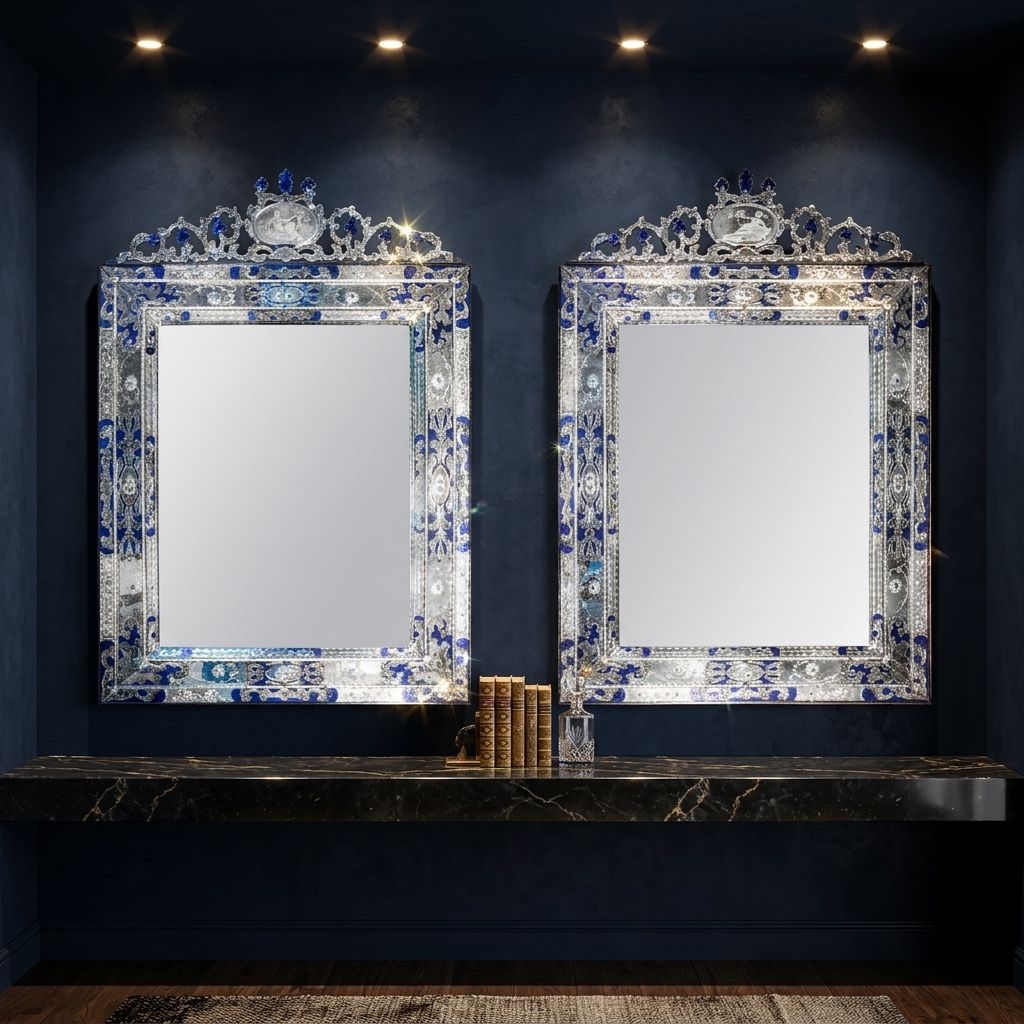
The reproduction market for vintage Venetian mirrors is substantial and occasionally sophisticated. Here is what to examine when assessing any piece.
The reflection and foxing pattern is the first and most important test for any mirror claiming mercury-tin backing. Genuine pre-1835 mercury glass produces a reflection that is slightly soft, marginally grey-toned, and luminous in a way that modern silver-nitrate glass is not. The foxing (the spots and irregularities that develop as mercury degrades over centuries) appears as organic, irregular marks concentrated near the edges and sometimes toward the center of the plate. Uniform black dots applied by spray paint or sponge are a definitive reproduction indicator.
The glass surface and bevels reveal their age under close examination. Antique glass was not float glass; it was blown or cast, which introduces a very slight waviness visible when you look across the surface at a shallow angle. Small air bubbles (called seeds) may be visible within the glass itself. Hand-cut bevels show subtle irregularities. These are slight variations in angle and depth that are the signature of human work. Perfectly uniform bevels with crisp, identical profiles are almost always mechanical.
The reverse and construction are often the most conclusive evidence. Turn the mirror over and examine the backboard: hand-sawn oak or pine with forged square-headed nails or wooden pegs are consistent with period production. Plywood backs, Phillips-head screws, and modern adhesives are not. The method by which glass rosettes are secured—whether by the original wire-and-peg construction or by modern adhesive—is also revealing. If you can examine the reverse of the frame sections, look for hand-tool marks in any wooden substructure rather than the smooth uniformity of machine-sawn timber.
Where to Buy Authentic Venetian Mirrors—and What Each Source Offers
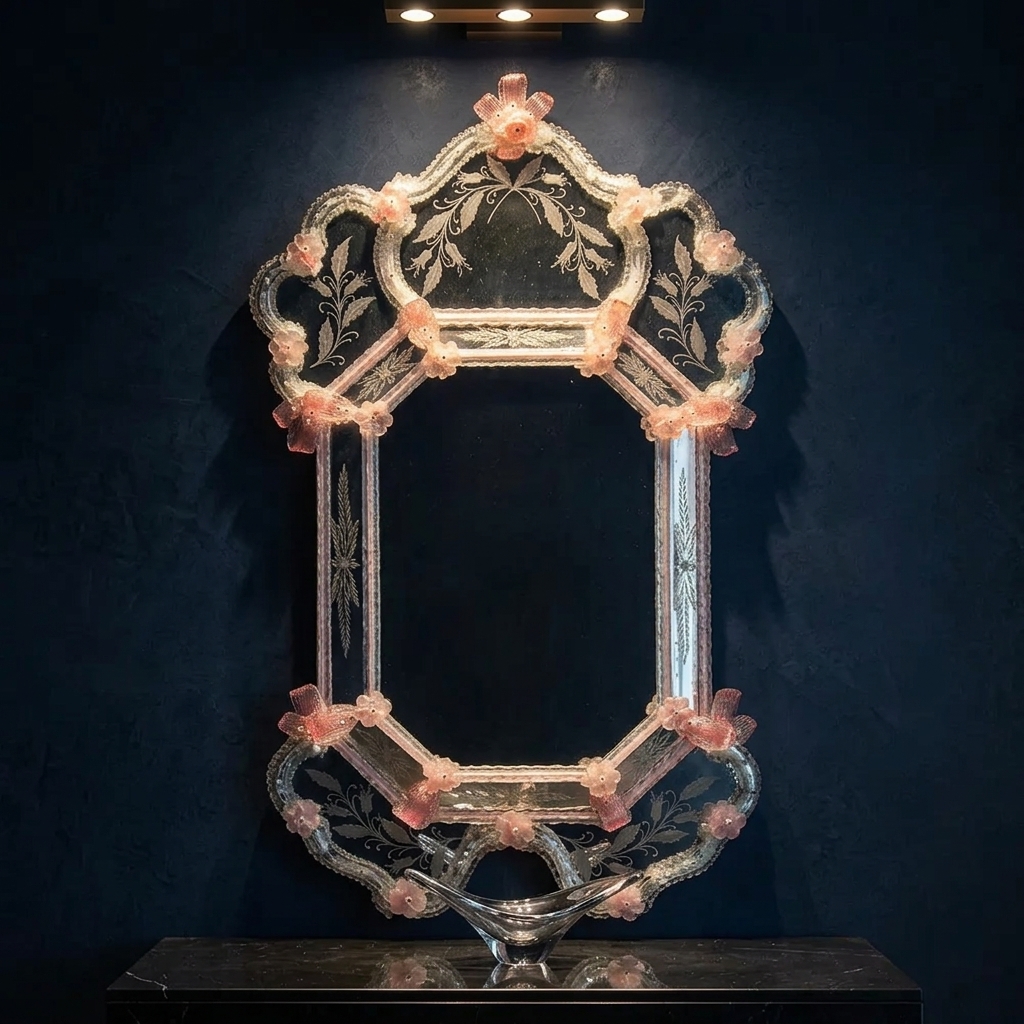
Finding a genuine antique Venetian mirror requires knowing not just what to look for but where to look. The market spans everything from world-class auction houses to specialist Venetian dealers, and each channel offers a different combination of selection, authentication confidence, and price.
Major Auction Houses
Christie’s, Sotheby’s, and Bonhams are the most reliable sources for museum-quality Venetian mirrors at the top of the market. All three regularly feature important pieces in their decorative arts and European furniture sales, accompanied by condition reports, provenance documentation, and in-house specialist authentication. The advantages are considerable: you know exactly what you are buying, the provenance trail is as complete as it is likely to get, and the competitive bidding environment means prices reflect genuine current market demand. The disadvantages are equally clear. Buyer’s premiums add significantly to the hammer price (typically 25–28%) and the finest pieces attract serious competition from institutional buyers and established collectors. For first-time buyers, attending previews at major auction houses before bidding is strongly advised. Handling the pieces in person is irreplaceable as an education in what genuine period construction feels and looks like.
Specialist Antique Dealers
The most knowledgeable sources in the Venetian mirror market are the specialist antique dealers who have built careers around this category. In Venice itself, dealers on and around the Calle delle Botteghe and the antique trade concentrated near the Dorsoduro sestiere offer direct access to pieces with Italian provenance. In London, dealers within the LAPADA network and those concentrated in Kensington Church Street and the Portobello Road market are the most reliable starting points. In New York, the network of dealers operating through the Manhattan Art and Antiques Center and the broader Upper East Side dealer community includes several specialists in Italian decorative arts. The advantage of buying from a specialist dealer over an auction house is the relationship. A good dealer will educate you, alert you to pieces that match your collecting focus before they reach the open market, and stand behind the pieces they sell in a way that an auction house, which merely facilitates a transaction, does not.
Online Platforms — 1stDibs and Chairish
For collectors outside major urban centers, or those who prefer to research at their own pace, 1stDibs and Chairish have become the dominant online marketplaces for antique and vintage Venetian mirrors. Both aggregate inventory from dealers worldwide, allow direct communication with sellers, and offer buyer protections that make online purchasing considerably safer than it was a decade ago. The selection is genuinely impressive. Both platforms carry pieces across every era and price point, from accessible mid-century Murano frames in the low thousands to baroque period pieces commanding five figures. The critical discipline when buying online is insisting on detailed photographs of the reverse, close-up images of the foxing pattern and bevel quality, and a written condition report before committing. If a dealer cannot or will not provide these, that is your answer.
Vintage Dealers and Antique Fairs
The Biennale des Antiquaires in Paris, the TEFAF fair in Maastricht, and the Winter Antiques Show in New York are the three most important fairs for serious Venetian mirror collectors at the upper end of the market. For mid-range and accessible pieces, regional antique fairs—particularly in Italy, France, and the United Kingdom—regularly surface excellent examples at prices that reflect local rather than global demand. The Portobello Road market in London and the Marché aux Puces at Saint-Ouen in Paris both reward patient, regular attendance with occasional significant finds.
What Drives Price—and When a Mirror Becomes an Investment
Across all these sources, the factors that drive Venetian mirror value follow a consistent hierarchy. Era is the primary determinant. A genuine 17th or 18th-century baroque piece with mercury-tin backing commands a multiple of what a comparable 19th-century revival piece achieves. Size matters significantly, too. Large-format pieces with intact, undamaged frame elements are considerably rarer than smaller examples, because the fragility of multi-plate glass construction means that large pieces have survived in disproportionately lower numbers. Condition is critical. Intact glass rosettes, unrepaired bevels, and original backing in stable condition add a substantial premium over restored or partially replaced examples. And provenance, such as a documented ownership history, an appearance in a published collection catalogue, or a connection to a significant interior, elevates value in a way that no amount of visual quality alone can replicate.
Shop editor’s picks
Interior Styling: Integrating Venetian Mirrors into Contemporary Spaces
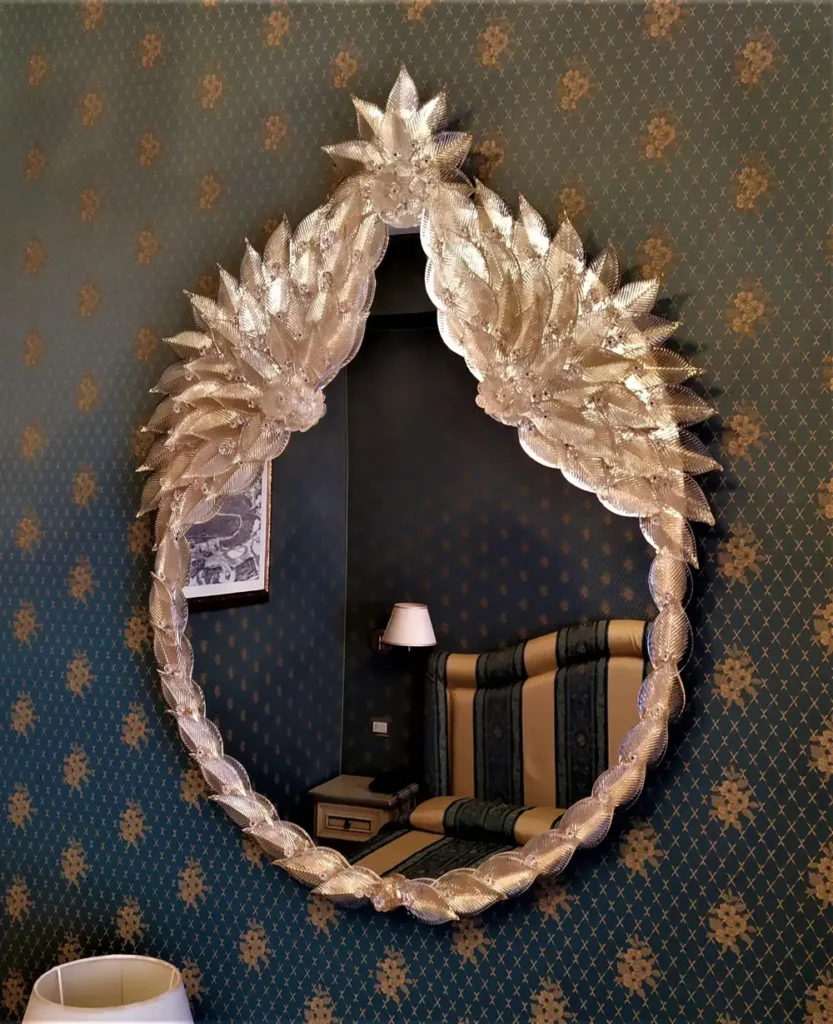
The conventional wisdom about antique Venetian mirrors, that they belong in period rooms with matching furniture and formal decorating schemes, is outdated and limiting. The most interesting interiors using these pieces today deploy them in deliberate contrast with their surroundings.
The high-low juxtaposition is the most reliable approach. A baroque Venetian mirror with an elaborate glass cimasa placed above a raw concrete console, a poured plaster fireplace surround, or a minimal oak shelf. The contrast between the mirror’s extraordinary decorative complexity and the architectural restraint of its setting amplifies both elements. The mirror looks more extraordinary. The room looks more considered.
Lighting is critical to getting Venetian mirrors right. The glass rosettes, avventurina accents, and beveled segments of a fine frame are designed to catch and scatter light. Position the mirror to reflect warm ambient light, an adjacent lamp, or ideally a chandelier. The interaction between the frame’s glass elements and the reflected light source creates a visual effect that no other decorative object in a room can replicate.
For preservation, the primary rules are simple. Never use commercial glass cleaners on mercury-backed or vintage Venetian mirrors. The chemicals in products will degrade the silvering at the edges, accelerating foxing and potentially causing irreversible damage to the backing. Use a barely damp soft cloth for dust, and nothing more aggressive. When mounting multi-plate Venetian mirrors, always secure to wall studs rather than plasterboard, using appropriate mirror-plate hanging hardware. These are objects built to last centuries; the mounting should match the ambition.
Conclusion: Why Venetian Mirrors Remain the Ultimate Collector’s Object

Venetian mirrors have survived every shift in taste, technology, and cultural priority for five centuries. It did that by being genuinely, measurably extraordinary objects of a visual complexity and material richness that no industrial process has convincingly replicated. The mercury-tin-backed antique Venetian mirror with its hand-engraved glass segments, avventurina border accents, and glass rosette hardware is not simply a decorative object. It is the accumulated knowledge of generations of Murano craftspeople, expressed in a medium of extraordinary fragility and preserved, against all probability, to the present day. For the collector of beautiful things, that is not merely a purchase. It is a privilege.
Featured image: 1stDibs

Lydia Oladejo is a creative writer with over seven years of experience writing intriguing stories and engaging content. As a Staff Writer at Sewelo, she explores the artistry and history of high jewelry, blending her expertise in storytelling with a passion for luxury design.