

When Cartier chose to unveil its latest high jewelry collection against the sun-drenched backdrop of the French Riviera, the setting felt almost inevitable. There is a particular quality to Mediterranean light that strips every stone down to its truest self. And truth, in every facet and color, is precisely what Cartier Le Chœur des Pierres is about.
Unveiled at Château Saint-Maur, a 17th-century Provençal estate outside Saint-Tropez filled with works by Damien Hirst, Yves Klein, and Anselm Kiefer, the collection was presented to editors, international clients, and a constellation of global celebrities including Zoë Saldaña, Tilda Swinton, and Shu Qi. The inaugural chapter comprises more than 125 unique pieces, demanding over 85,000 hours of meticulous work from Cartier’s master artisans in Paris.
A Name with Two Meanings
The title of the collection is itself a kind of jewel—a linguistic gem that only French can produce. The name, meaning literally “the chorus of stones” in English, can also be read as “the heart of stones,” because the French words chœur (chorus) and cœur (heart) sound identical. This duality is not merely poetic decoration. It is the philosophical engine driving every single piece. Pierre Rainero, Cartier’s director of image, style, and heritage, explained that the collection’s focus on stones was particularly representative of the maison’s DNA, especially in “the association of colors, volumes, and different cuts.” “We also wanted to highlight that we work with different stones together,” he continued. “So that’s why there was an idea of chorus and heart,” playing on the homophony between their French translations.
For Jacqueline Karachi-Langane, director of high jewelry creation at Cartier, every design journey begins not on the drafting table but in the stone itself. “Letting a stone speak is to recognize in it a memory of the world, a beauty shaped by time and imbued with eternity,” she said at the collection’s reveal. It is a philosophy that places the gemstone, not the setting, not the gold, not the prestige of the house, at the absolute centre of creative decision-making. Each creation, from a panther-motif necklace to an abstract geometric bracelet, is meant to showcase the stones and highlight their beauty.
The Making of a Symphony
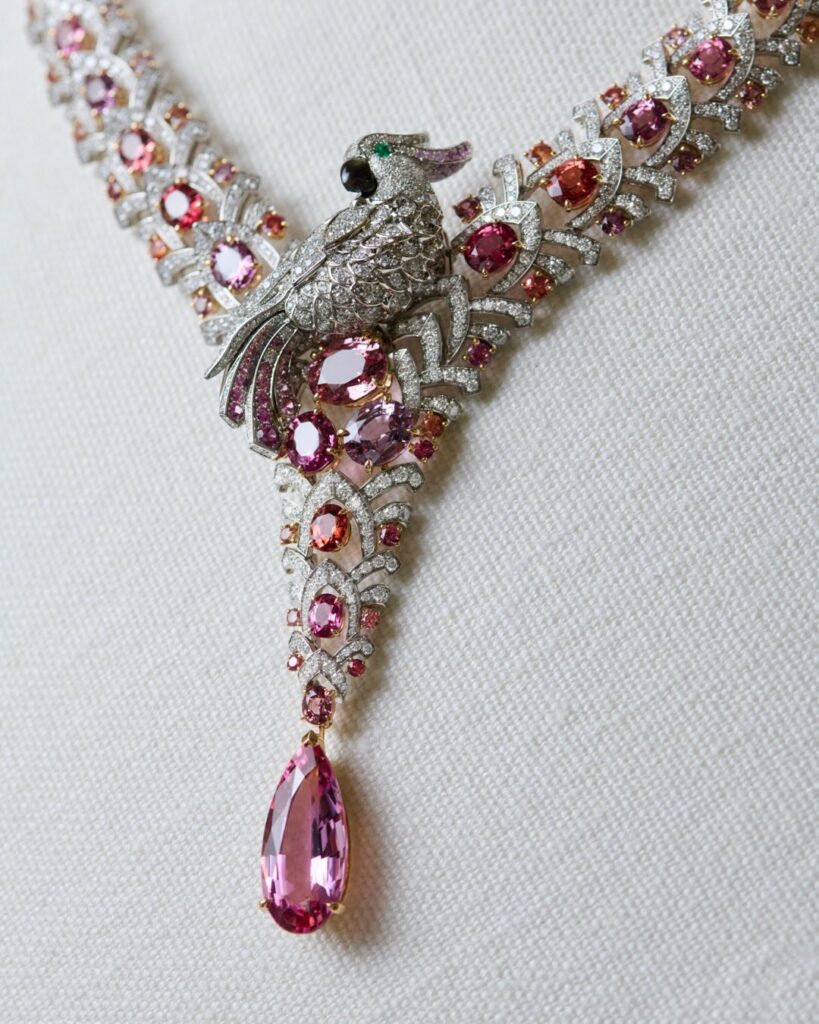
This collection is the result of collaborative mastery between designers and artisans, representing the harmonious work of stone experts, jewelers, lapidaries, gem-setters, and polishers, all working in perfect unison. The sheer scale of production behind Cartier Le Chœur des Pierres is staggering. More than 85,000 hours of work span across the Parisian ateliers, with each of the 125-plus pieces being entirely one-of-a-kind. As Alexa Abitbol, Director of the High Jewelry Workshops, described it: the collection is “an ode to gemstones, a dazzling symphony in which each gem sings its own melody.”
The gemological ambition of the collection matches its emotional reach. The collection unites gems ranging from intensely colored Colombian emeralds to uniquely shaped diamonds and weighty topazes. Rare colored diamonds make appearances alongside vivid blue sapphires, fiery red rubies, and cabochon stones of extraordinary scale. There’s the green-blue pairing, something of a taboo when Cartier first used it in the early 1900s as “a very good idea to promote a different aspect of beauty,” according to Rainero.
The Standout Pieces
Haryma — The Tiger Necklace

Few pieces generated more immediate conversation than Haryma, a necklace that channels one of Cartier’s most beloved animals. The Haryma necklace honors the tiger with five imperial topazes totalling 28.04 carats, joined by garnets and white, yellow, and orange diamonds in colors that mirror its coat. The topazes are set in a staggered, staircase-like line that suggests upward movement, while a finely sculpted tiger prowls across them like a gemstone terrace. Custom-cut onyx rectangles run through the chain in a pixelated stripe, extending the animal’s markings around the neck. Zoë Saldaña wore this piece at the Saint-Tropez unveiling, instantly cementing it as the defining image of the evening.
Panthère Kentia — The Panther’s Return
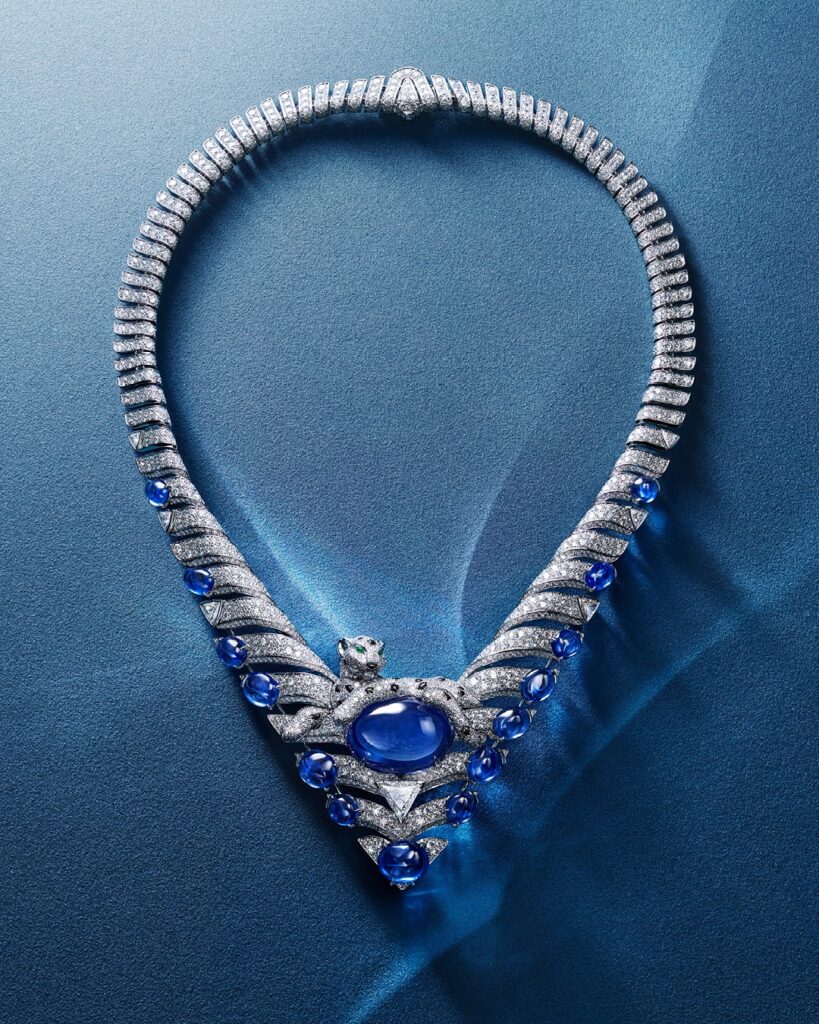
The panther, Cartier’s most enduring symbol, makes a spectacular statement in Panthère Kentia. A 50.13-carat cabochon Ceylon sapphire forms the heart of a necklace that balances generous volume with sharp geometry. Stylised botanical motifs in white gold and diamonds ripple outward, their three-dimensional forms recalling palm fronds or fan leaves, while small sapphire cabochons dot the outer edge. On one side, the panther, sculpted in full relief with emerald eyes and custom-cut onyx spots, anchors the design. It is simultaneously the most classically Cartier piece in the collection and one of its most audacious.
Olorra — The Green-Blue Dialogue
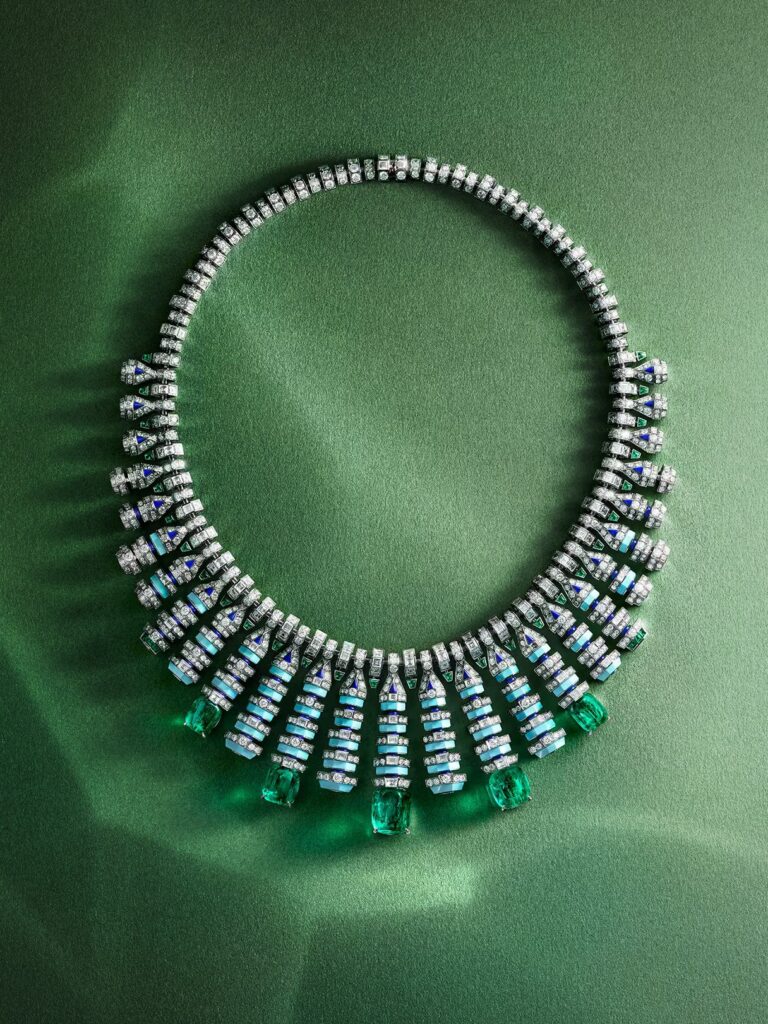
The Olorra necklace features five Colombian emeralds weighing a total of 40.67 carats. These exceptional stones determined the structure of the remarkable piece, offering a unique interpretation of the iconic green-blue contrast that first appeared in Cartier’s repertoire in the early 20th century. Custom-cut turquoise and lapis lazuli stones alternate with diamonds to form geometric pendants, creating a visual symphony that is both rhythmic and graphic.
Tutti Kanya — A Heritage Reimagined
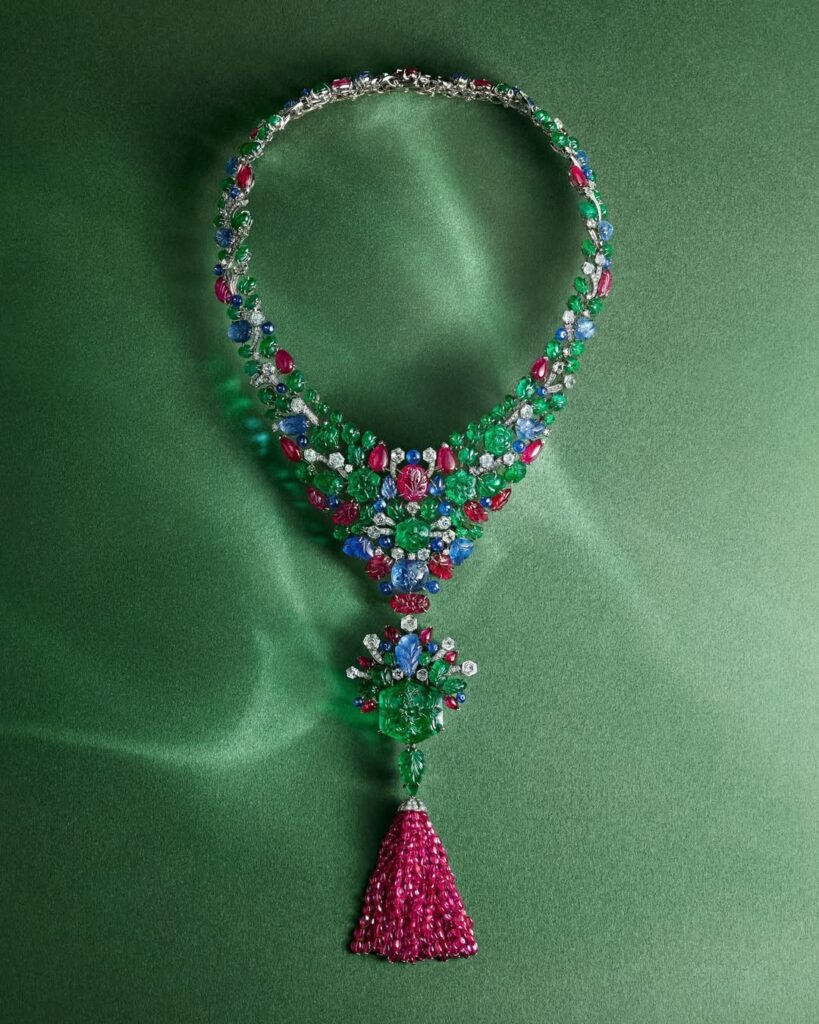
The Tutti Kanya necklace features as its centrepiece a stunning 30.33-carat engraved emerald from Zambia, surrounded by flowers, leaves, and berries made of rubies, sapphires, and emeralds. It is an homage to Cartier’s legendary Tutti Frutti motif, first created in the 1920s at the height of Art Deco fascination with India. Here, it has been elevated to new heights with a stone of exceptional provenance and rarity.
Solenara — Tilda Swinton’s Choice
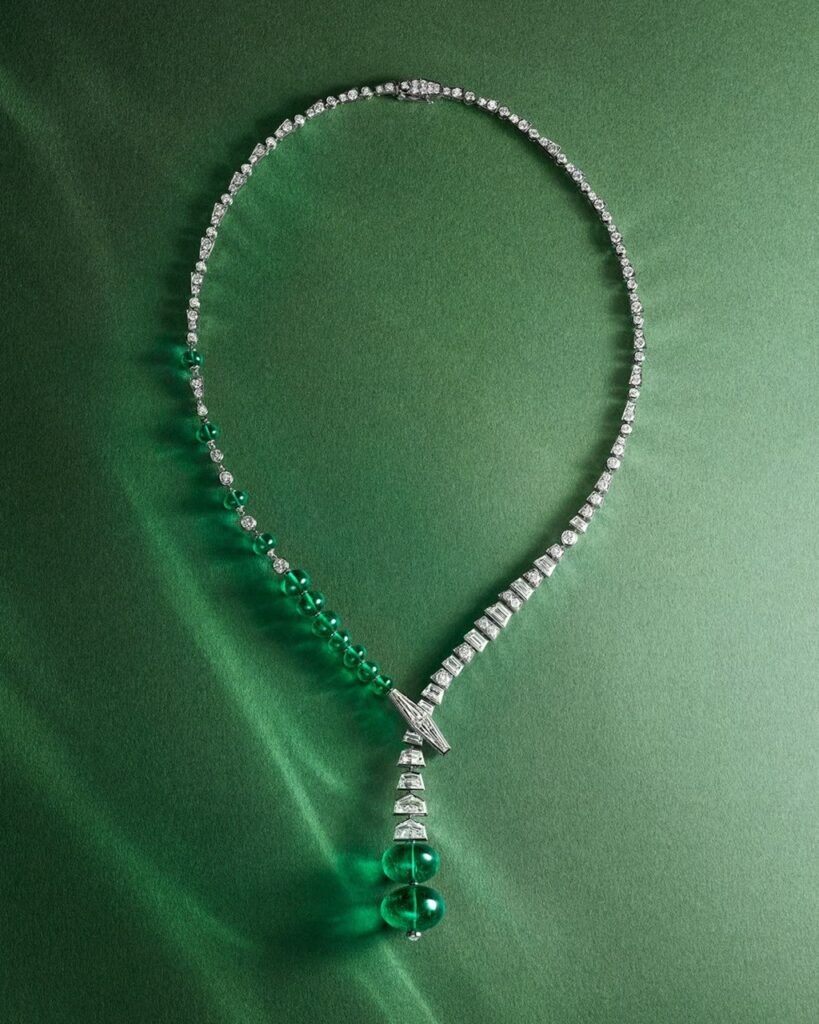
The Solenara necklace was the piece Tilda Swinton wore to the launch, and the choice speaks volumes. The necklace celebrates the maison’s taste for classic design through a slew of remarkable emeralds and diamonds, notable for their quality and shape. Each emerald resonates with its own intensity, its organic roundness contrasting beautifully with the geometry of the diamonds.
Tellura — Architecture in Motion

The sculptural and architectural Tellura necklace suspends 30 hand-selected diamonds side-by-side inside an articulated white-gold frame of openwork and pavé scrolls, replicating raw volcanic energy. It is perhaps the most avant-garde creation in the collection, sitting at the intersection of jewelry and kinetic sculpture.
Auralis — Quiet Rarity
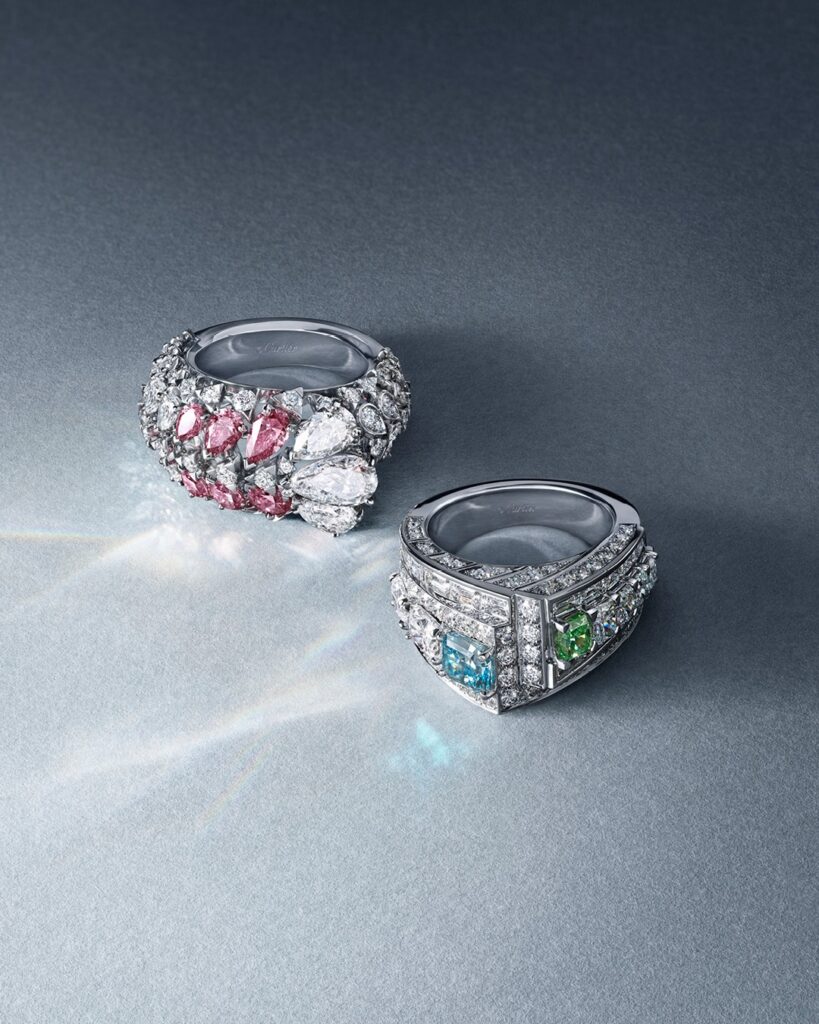
Not all of the collection’s most significant pieces are its most visually bombastic. The Auralis ring, built around six pink diamonds from Australia’s now-closed Argyle mine, totals just 1.42 carats, but provenance, increasingly, is its own form of luxury. In Auralis, the provenance matters as much as scale at this level of high jewelry craftsmanship.
What the Collection Signals

Cartier Le Chœur des Pierres is a statement of intent as much as it is a collection of objects. In an era when luxury consumers are increasingly focused on the origin and quality of materials, the maison doubles down on its identity as a custodian of the world’s finest stones. Collections such as Le Chœur des Pierres also indicate continued demand for rare colored gemstones and bespoke craftsmanship at the highest end of the market, despite ongoing global economic uncertainties.
It is also a love letter to the idea that the most extraordinary things in the world don’t need to be created; they simply need to be found, understood, and honored. In the words of the collection’s own philosophy: letting a stone speak is to recognise in it a memory of the world. With Cartier Le Chœur des Pierres, Cartier has listened very carefully indeed.
Featured image: Courtesy of Cartier

Sewelo is a world where jewelry, watches, and objects come alive in a shimmering dance of fantasy. Through a literary lens, we celebrate the beauty and elegance that make these treasures more than just possessions.