The Van Cleef & Arpels ballerina brooch represents one of haute joaillerie’s most beloved and enduring motifs. These exquisite pieces capture dancers frozen mid-movement, their forms adorned with thousands of meticulously set gemstones, creating tutus that seem to flutter with life. Since their introduction in the early 1940s, these enchanting brooches have captivated collectors with their whimsical elegance, each piece telling a story of grace, beauty, and the timeless allure of dance.
What makes the Van Cleef & Arpels ballerina brooch so extraordinary? It’s the convergence of exceptional craftsmanship with each tutu requiring days of painstaking hand-setting, innovative design capturing three-dimensional movement in precious materials, cultural significance reflecting post-war hope and artistic escapism, and genuine rarity with production estimated in the hundreds rather than thousands. From the diamond-encrusted faces to the flowing tutus adorned with rubies, emeralds, and sapphires, these brooches transcend jewelry to become miniature sculptures celebrating the eternal poetry of dance.

Understanding these iconic pieces requires exploring their origins in wartime New York and Paris, the technical mastery behind their creation, and why they remain among the most sought-after vintage jewelry pieces at auction today.
What Are Van Cleef & Arpels Ballerina Brooches?
The first brooches were completed in the early 1940s, and were elegant symbols of beauty and poise, with long-legged dancers on pointe, surrounded by flowing skirts or tutus set with gemstones. These clips danseuses, or dancer clips, feature graceful twirling and leaping ballerinas with signature rose-cut diamond faces and fanciful tutus created from carefully selected gemstones.

Each ballerina is a one-of-a-kind piece, with one commonality: The dancers all have a rose-cut diamond face. This unifying feature connects hundreds of unique variations, with each brooch showcasing different poses—from perfectly poised pirouettes to relaxed arabesques—and distinct costume designs using various combinations of diamonds, colored gemstones, and precious metals.
What distinguishes ballerina brooches from other figurative jewelry is their three-dimensional quality and sense of movement. These precious brooches capture a dancer mid pose, with her form often adorned with diamonds or richly colored gemstones, such as turquoise, lapis lazuli, emeralds, and rubies. The tutus appear to drape like actual fabric, with gemstones adding texture while creating the costume’s shape. The brooches replicate movements of human ballet—jetés, pirouettes, arabesques—with each figurine positioned to suggest the fluid grace of dance.
The association with elegance and movement stems from Van Cleef & Arpels’ deep connection to the performing arts. These weren’t generic figurines but carefully studied representations inspired by actual ballet legends and performances.
The Origins of the Ballerina Motif
Post-War Paris and New York
With World War II wreaking havoc in Europe, it seemed safer to be in the U.S. Van Cleef & Arpels had opened its New York location in 1939, and several members of the Arpels family remained in America as instability grew in Europe. But it was not a time for splurging, and the company responded by producing accessible, lighthearted pieces, including the ballerina brooches.

The Ballerinas offered Van Cleef & Arpels customers some respite from the fear and upheaval caused by World War II, which raged on in the early 1940s. In times of darkness and uncertainty, these whimsical jewels provided escapism and beauty—reminders that art, grace, and elegance persisted despite global turmoil. They represented hope, lightness, and the enduring human spirit.
The Influence of Ballet and Performance Arts
Louis Arpels’ passion for ballet directly inspired the ballerina brooches. He attended performances regularly, often with his nephew Claude, sharing a deep love of dance. Through these jewels, Louis found a way to give his clients a taste of the escapism he so enjoyed whenever he watched ballet in a hushed theatre.

The Arpels family’s connections to the dance world ran deep. Louis Arpels was friends with George Balanchine, one of history’s most famous ballet choreographers, and this relationship enriched the family’s understanding of dance as an art form. By then, the jewelry firm was well-known for its ballerina clips, the signature bejeweled brooches that were introduced to great popularity during World War II. This relationship would later inspire Balanchine’s 1967 masterpiece Jewels—a three-act ballet celebrating emeralds, rubies, and diamonds.
Creative Collaboration
The first brooches were a collaboration between Van Cleef & Arpels designer Maurice Duvalet and John Rubel of jewellery manufacturer Rubel Freres, both of whom had emigrated from Paris to New York. Maurice Duvalet, a consummate draftsman with an unerring sense of style, studied paintings and photographs of ballet’s most famous names for inspiration.

Some were modeled after legends such as the famed 18th-century French dancer Marie Camargo and the turn-of-the-century Russian luminary Anna Pavlova. Duvalet drew from historical paintings depicting Marie Anne de Cupis de Camargo and photographs of Anna Pavlova, the first ballerina to tour and dance worldwide. Legend has it that the rose-cut diamonds that Van Cleef & Arpels had acquired for the original Ballerina brooches had once been part of the Spanish Crown Jewels.
Design Characteristics of Van Cleef & Arpels Ballerina Brooch
Gemstones and Materials
The Van Cleef & Arpels ballerina brooch showcases the maison’s mastery of gemstone selection and setting. Diamonds form the foundation—rose-cut diamonds for faces, brilliant-cut diamonds for tutus, bodies, and accessories. The consistency of rose-cut diamond faces across all ballerinas creates immediate recognition while allowing infinite variation in everything else.

Colored gemstones provide personality and distinction. Rubies create passionate red costumes, sapphires offer regal blue attire, emeralds bring verdant elegance, and turquoise and lapis lazuli add unexpected color. The ballerinas made in Paris were considered to be less formal daytime wear brooches, with tutus embellished with turquoise and rubies, while the ballerinas that were fabricated in New York were more formal and meant for evening wear with tutus adorned with diamonds, sapphires, rubies, and emeralds.
The use of hardstones alongside precious gems demonstrates Van Cleef & Arpels’ commitment to color and design over convention. Gold (yellow, white, rose, and sometimes platinum) provides the structural framework, carefully shaped and textured to suggest fabric while remaining invisible beneath gemstones.
Movement and Illusion
The genius of ballerina brooches lies in creating convincing illusions of movement and fabric in rigid materials. The raised skirts suggest mid-spin momentum, dynamic positioning captures specific ballet poses with anatomical accuracy, and the illusion of motion emerges from careful pose selection and flowing tutu designs.

In addition to wearing different costumes (although they all wear point shoes), the ballerinas also capture the movement of various dance poses from pirouettes to aerial jetés. These precious dancers replicate the movements of human ballet. Each figurine freezes a specific moment—a leap captured at its apex, a turn balanced on pointe, an arabesque extended in perfect line.
Craftsmanship and Techniques
Creating a single Van Cleef & Arpels ballerina brooch requires extraordinary skill and patience. Hand-set pavé work places thousands of tiny gemstones individually, with each stone selected for size, color, and clarity to create seamless transitions across the tutu. The density and precision of the setting create surfaces that read as fabric despite being composed of individual gems.

Sculptural metalwork provides hidden infrastructure. The metal framework must support gemstone weight while remaining flexible enough to allow three-dimensional form. It must be strong enough to secure stones permanently yet delicate enough to disappear beneath them. Precision in facial and bodily proportions requires understanding of human anatomy and ballet technique, ensuring each dancer appears realistic and graceful rather than awkward or distorted.
Later examples incorporated the Mystery Set technique, Van Cleef & Arpels’ patented invisible setting, where gemstones appear to float without visible prongs. Mystery-set tutus create continuous waves of color, requiring at least 300 hours of labor per piece.
Famous Designs and Variations
The Spanish Dancer

One of the most celebrated examples is La Danseuse Espagnole (The Spanish Dancer) from 1941, featuring diamonds, emeralds, and sapphires. This brooch captures a flamenco dancer mid-pirouette, perfectly poised with the slender discipline and excellence characteristic of Spanish dance. The combination of cultural influence—flamenco rather than classical ballet—with Van Cleef & Arpels’ signature elegance created an instant icon.
La Camargo

Perhaps the most famous vintage Van Cleef & Arpels ballerina brooch depicts 18th-century French dancer Marie Anne de Cupis de Camargo, known simply as La Camargo. With her pear-shaped diamond face, ruby headpiece, and multi-tiered diamond dress with swags of rubies and emeralds, La Camargo is forever young. When the brooch was sold in 2009 at Christie’s, its $422,500 price set a new record.
Classic Tutu Ballerinas

The most recognizable designs feature dancers in traditional tutus—multi-layered skirts created from carefully graduated gemstones. These range from simple diamond-set tutus creating pure white elegance to elaborate multi-colored designs mixing rubies, sapphires, emeralds, and colored diamonds.
Limited Production and Bespoke Pieces
It is not known how many ballerinas Van Cleef & Arpels has created, but the figure is estimated to be in the hundreds, making this jewelry icon a rare find. Van Cleef & Arpels stopped production of the Ballerina Brooches in the 1960s. However, it was reintroduced in the 2000s and has appeared periodically in various high jewelry collections. Then in 2018, VCA created a series of 12 Ballerina brooches inspired by the Grimm Brothers fairy tale, “Twelve Dancing Princesses” for Haute Couture Week.
The Golden Era: 1940s and 1950s
The 1940s and 1950s produced the most iconic Van Cleef & Arpels ballerina brooches, establishing the design vocabulary that defines these pieces today.
1940s Characteristics
Early 1940s ballerinas reflected wartime material constraints and the desire for escapist beauty. They featured slightly simpler construction compared to later examples, greater use of colored stones beyond traditional precious gems, and bold, confident poses reflecting defiance against wartime darkness.
1950s Evolution
In the 1950s and 1960s, Ballerina pins were characterised by a wider use of color, reflecting the burgeoning prosperity and evolving tastes of the post-war period. The 1950s brought increased prosperity, allowing for more elaborate designs. Brooches from this era show richer gemstone palettes, more complex poses and attitudes, integration of the Mystery Set technique in later examples, and larger, more substantial pieces reflecting confident post-war optimism.
Value and Collectibility
What Determines Value
The Van Cleef & Arpels ballerina brooch ranks among the most valuable vintage jewelry categories. Several factors determine individual brooch values:
- Condition: Pristine examples with no missing stones, damage, or repairs command significant premiums. Even minor damage—a replaced gemstone, repaired pin mechanism—reduces value.
- Gemstone quality: The caliber of diamonds and colored stones significantly impacts value. Fine gemstones with excellent color, clarity, and cutting increase worth substantially.
- Rarity: Certain designs are rarer than others. Specific poses, unusual color combinations, or documented limited production increase scarcity and desirability.
- Provenance: Documented ownership history, particularly pieces from famous collections or worn by notable figures, adds significant value. Brooches appearing in Van Cleef & Arpels archives or historical exhibitions command premiums.
Why Collectors Compete
A dedicated collector base seeks out the ballerina pins, especially those from the 1940s and ’50s, with sales averaging in the mid- to upper $200,000 range. These brooches appeal to multiple collector categories—vintage jewelry enthusiasts, Van Cleef & Arpels specialists, and those drawn to figurative jewelry and dance-inspired art. The combination of artistic merit, technical excellence, historical significance, and genuine scarcity creates sustained demand that consistently drives auction results beyond estimates.
Auction Performance
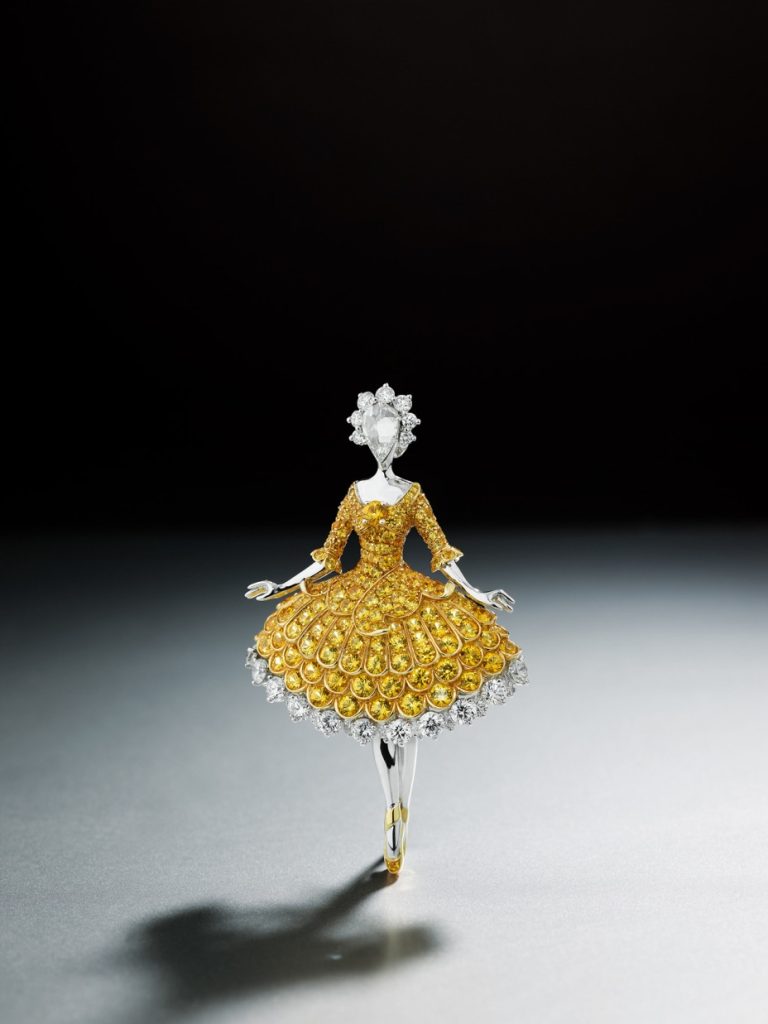
Major auction houses regularly feature ballerina brooches in their finest jewelry sales. A Van Cleef & Arpels ballerina clip in diamonds, rubies, and emeralds, dating from 1942, achieved a record price of $422,500 at a Christie’s sale in New York on October 21, 2009. The clip, representing the famous ballerina Maria Camargo, far exceeded its estimate of $80,000 to $120,000.
Recent notable sales demonstrate sustained market strength. Brooches regularly exceed estimates by two to three times, with exceptional examples achieving prices in the mid-six figures. The combination of Van Cleef & Arpels’ overall auction performance, up 28% in recent years, and specific demand for ballerina brooches creates a robust market.
Collectors compete intensely for quality examples, recognizing that opportunities to acquire these pieces arise infrequently. As original owners pass away and estates disperse collections, each auction presents limited chances to obtain historically significant examples.
Authentication and Collecting
Hallmarks and Signatures
Authentic pieces bear Van Cleef & Arpels signatures, typically “VCA” or “Van Cleef & Arpels,” along with metal marks and often serial numbers. Paris-made pieces show French assay marks, while New York pieces display appropriate American markings.
Construction Features
Authentic ballerinas show exceptional construction quality throughout. The rose-cut diamond face is consistent across genuine pieces, pavé work displays extraordinary density and precision, metalwork shows careful finishing even in non-visible areas, and pin mechanisms operate smoothly with quality engineering.
Importance of Documentation
For valuable pieces, original Van Cleef & Arpels boxes, certificates, and documentation significantly enhance value and authentication confidence. The maison’s heritage department can sometimes verify pieces using archive records, providing definitive authentication for documented examples.
Conclusion: Enduring Beauty

The Van Cleef & Arpels ballerina brooch endures as one of jewelry history’s most beloved motifs because it perfectly embodies the maison’s philosophy. Here, poetry comes in precious materials, technical mastery serves artistic vision, and jewelry tells stories beyond mere ornamentation. These dancing figures capture specific moments yet suggest eternal movement, freeze time while evoking fluidity, and combine precious materials with genuine emotion.
As we move further from their 1940s origins, these brooches gain historical significance while maintaining aesthetic relevance. They remind us that even in humanity’s darkest hours—the chaos of World War II—beauty, grace, and art persist. They celebrate ballet’s eternal appeal and jewelry’s power to capture ephemeral movement in lasting form.
For collectors, acquiring a Van Cleef & Arpels ballerina brooch means possessing both exceptional jewelry and a cultural artifact. Whether displayed as art or worn with pride, these exquisite pieces continue dancing their way into hearts, just as they have for over eight decades. They are timeless celebrations of grace, beauty, and the enduring magic of dance transformed into precious jewels.
Featured image: Van Cleef & Arpels

Amanda Akalonu is dedicated to weaving together the worlds of jewelry, watches, and objects through a lens of literary storytelling.