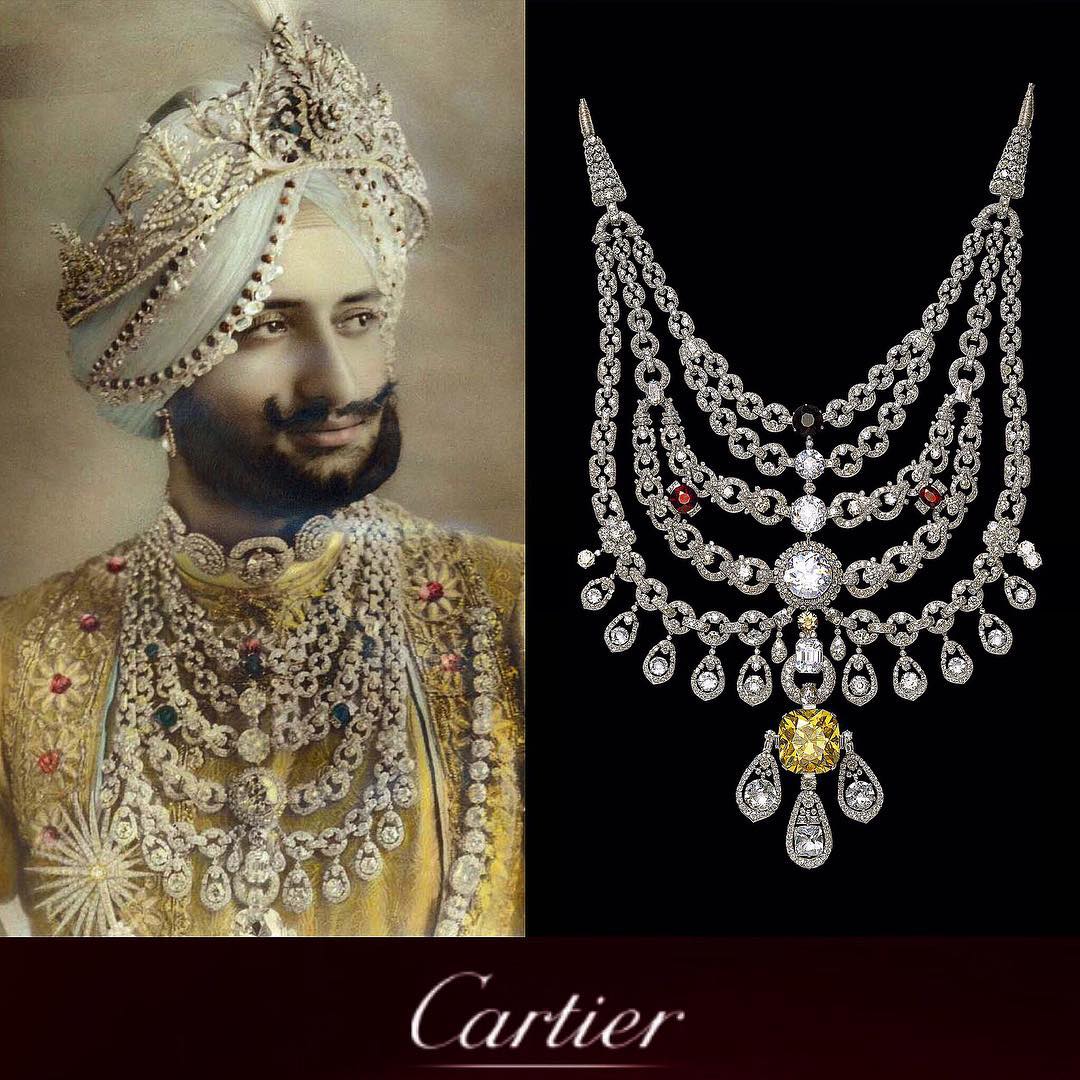

When it comes to legendary jewels that embody the intersection of royal extravagance, masterful craftsmanship, and historical intrigue, few pieces captivate quite like the Maharaja of Patiala Necklace. This extraordinary creation by Cartier stands as one of the most spectacular pieces of jewelry ever made, and its story is as dazzling as the diamonds it once held. From its creation in the opulent workshops of 1920s Paris to its mysterious disappearance and eventual rediscovery, this necklace represents the pinnacle of high jewelry artistry and the romance of a bygone era.
The Maharaja of Patiala Necklace: A Royal Vision Takes Shape
The story of the Maharaja of Patiala Necklace begins in 1925, when Maharaja Bhupinder Singh of Patiala made a journey that would become the stuff of jewelry legend. The Maharaja, known for his extraordinary wealth and passion for precious gems, arrived at the Cartier headquarters in Paris with an entourage befitting his status and a request that would challenge even the world’s most prestigious jeweler. He brought with him trunks brimming with some of the finest gemstones ever assembled: thousands of diamonds, emeralds as green as the monsoon valleys of India, sapphires that captured the depth of twilight skies, rubies the color of royal blood, and lustrous pearls from the waters of the East.
Maharaja Bhupinder Singh was no ordinary collector. Standing over six feet tall with a commanding presence, he was known for his love of cricket, his extensive polo stables housing hundreds of ponies, a garage filled with luxury automobiles, and a legendary jewelry collection. He commissioned Cartier to create not just one piece, but an entire collection of regalia that would showcase his position as one of India’s most powerful rulers. Among these commissioned pieces, the ceremonial necklace would become the crown jewel. Indeed, it was a statement of power, taste, and the synthesis of Indian royal tradition with European Art Deco design sensibilities.
Three Years of Unprecedented Craftsmanship
The creation of the Maharaja of Patiala Necklace would consume three years of intensive work, from 1925 to 1928. Teams of master craftsmen at Cartier’s Parisian ateliers worked meticulously to realize a design that would push the boundaries of what was technically possible in high jewelry. The sheer scale of the project was unprecedented: the necklace would feature five cascading rows of platinum chains, each one flowing like a waterfall of light, adorned with 2,930 diamonds totaling approximately 1,000 carats of pure brilliance.
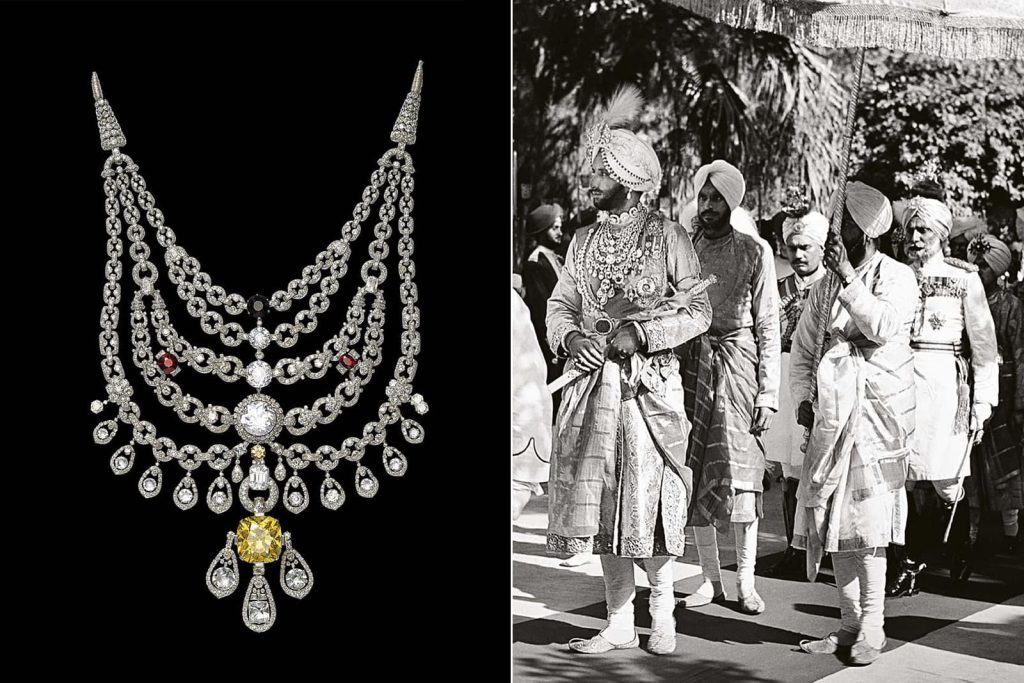
But numbers alone cannot capture the magnificence of this piece. The true showstopper was the centerpiece: the magnificent 234.65-carat De Beers yellow diamond, the seventh-largest diamond in the world at the time and the largest cushion-cut yellow diamond ever recorded. This extraordinary gem, with its warm honey-gold color and exceptional clarity, had been discovered in the Kimberley mines of South Africa in 1888. Surrounding this central sun were seven other exceptional diamonds, each one ranging from 18 to 73 carats—stones that would have been centerpieces in their own right on any other jewel. The finest Burmese rubies, known for their pigeon’s blood red color, punctuated the design, adding depth and royal symbolism to the composition.
The Maharaja of Patiala Necklace exemplified the Art Deco aesthetic that defined the Roaring Twenties. Geometric precision, bold scale, and luxurious materials met with exquisite craftsmanship. The platinum setting, still a relatively new material in jewelry at the time, allowed Cartier’s designers to create an almost invisible framework that let the diamonds take center stage. The cascading design meant that when worn, the necklace would drape across the chest like a bib, creating a complete collar of light that would catch every ray from chandeliers in the maharaja’s grand halls.
The Vanishing Act
The Maharaja of Patiala Necklace was last photographed in 1946, adorning the neck of Maharaja Yadavindra Singh, Bhupinder Singh’s son, shortly after India gained independence from British rule. This was a time of tremendous change for the princely states. The political landscape was shifting dramatically, and many royal families found themselves navigating new economic realities. By 1948, just two years later, the necklace had mysteriously vanished from the royal treasury in Patiala.
What happened to this magnificent jewel? The theories are as numerous as the diamonds it contained. Was it stolen during the chaos of partition and independence? Was it quietly dismantled and sold piece by piece to maintain the royal household’s lifestyle in changing times? Did political pressures force its secret sale? The silence from the royal family only deepened the mystery. For decades, jewelry historians, collectors, and treasure hunters speculated about the fate of one of the world’s most important pieces of jewelry, but no concrete answers emerged.
A Tale of Rediscovery
Then, in 1982, more than three decades after the necklace’s disappearance, the De Beers diamond resurfaced at a Sotheby’s auction in Geneva. It had been separated from its original setting, recut slightly, and was being sold as an individual stone. The jewelry world took notice, but the mystery of the complete necklace remained unsolved.
The plot thickened dramatically in 1998 when Eric Nussbaum, a well-known Cartier associate and jewelry expert, was browsing through a small second-hand jewelry shop in London. Among the hodgepodge of vintage pieces, something caught his expert eye: the distinctive platinum chains and portions of the setting that could only belong to one piece—the Maharaja of Patiala Necklace. However, the most spectacular stones that had made the piece legendary, including all the large diamonds and the precious Burmese rubies, had been removed, leaving only the skeletal framework of what had once been jewelry royalty.
Cartier’s Labor of Love
Determined to restore this important piece of jewelry history and preserve the memory of one of their greatest achievements, Cartier embarked on an ambitious four-year restoration project. Since acquiring the original stones was impossible (they were either lost to history, in private collections, or prohibitively expensive), Cartier made the decision to recreate the necklace using cubic zirconia and synthetic diamonds. This allowed them to be faithful to the original design while making the piece accessible for public viewing and education.
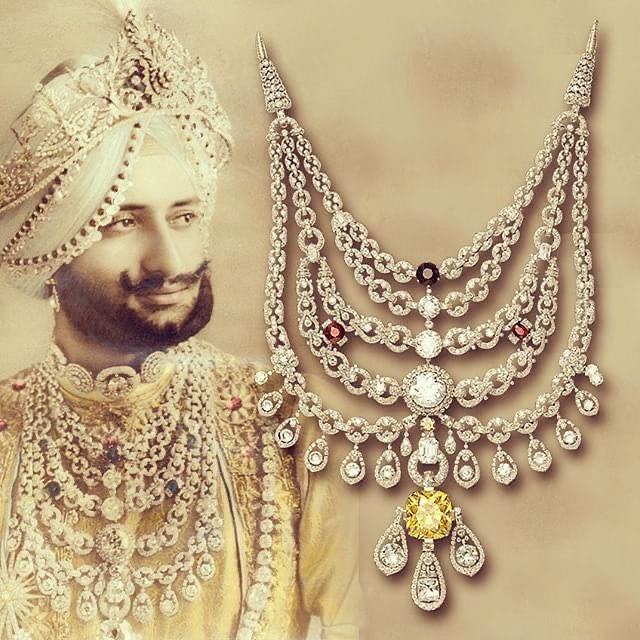
Using their original drawings, photographs, and the recovered platinum framework, Cartier’s artisans meticulously reconstructed every element of the Maharaja of Patiala Necklace. The goal was not to create a forgery, but to preserve a piece of jewelry history and allow new generations to witness the majesty of this extraordinary design. The restored necklace stands as a testament to Cartier’s archives and its commitment to preserving its heritage.
A Legacy Reborn
Today, the restored necklace continues to capture imaginations worldwide. It made a stunning contemporary appearance at the 2022 Met Gala, worn by YouTuber and Cartier brand ambassador Emma Chamberlain, introducing the historic piece to millions of young jewelry enthusiasts. The necklace has also been featured in museum exhibitions around the world, where it continues to inspire awe and wonder.
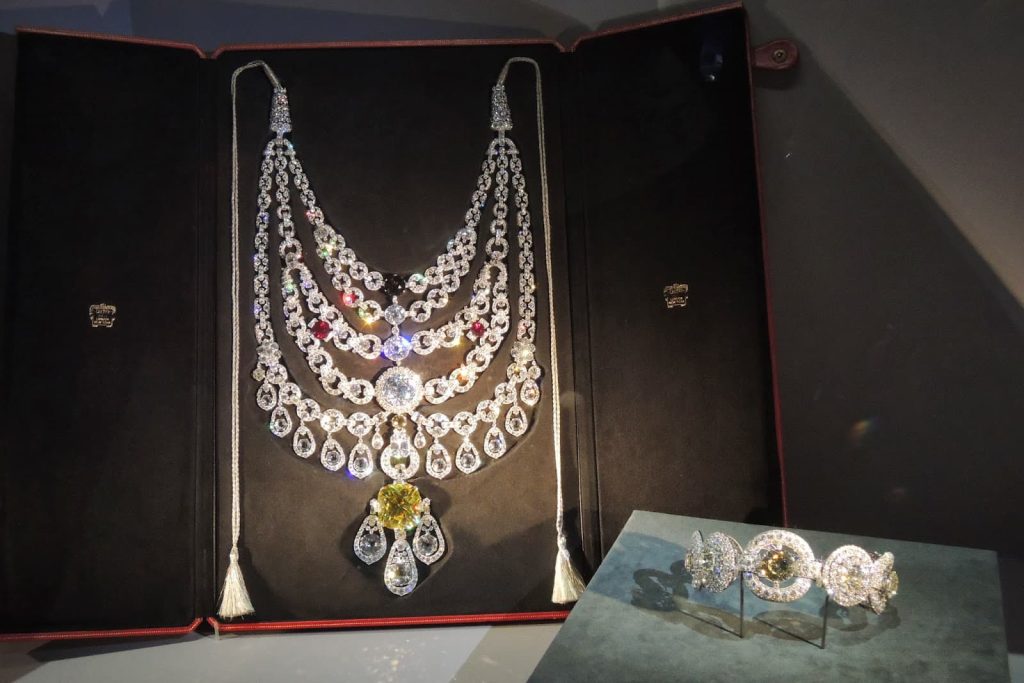
Though the original stones are scattered to the winds of history (the De Beers diamond existing separately, the other major stones lost or in unknown collections), the legacy of this masterpiece endures. The Maharaja of Patiala Necklace represents everything I adore about historic jewelry: ambitious design that pushed technical boundaries, breathtaking craftsmanship that took years to perfect, royal provenance that connects us to fascinating historical figures, and a mystery that keeps us endlessly intrigued.
Why I Love It
This week, I celebrate not just a necklace, but a legend that spans continents and centuries. The Maharaja of Patiala Necklace reminds us that jewelry is more than mere adornment. It’s art, history, and storytelling wrapped in precious metals and stones. It represents a moment when Indian royal magnificence met French artistic excellence, creating something that transcended both cultures to become a universal symbol of luxury and beauty. In an age of mass production, pieces like this remind us of the value of true craftsmanship, the importance of preserving our jewelry heritage, and the enduring human fascination with objects of extraordinary beauty.
Featured image: @yusef.bendriss/Instagram

Amanda Akalonu is dedicated to weaving together the worlds of jewelry, watches, and objects through a lens of literary storytelling.