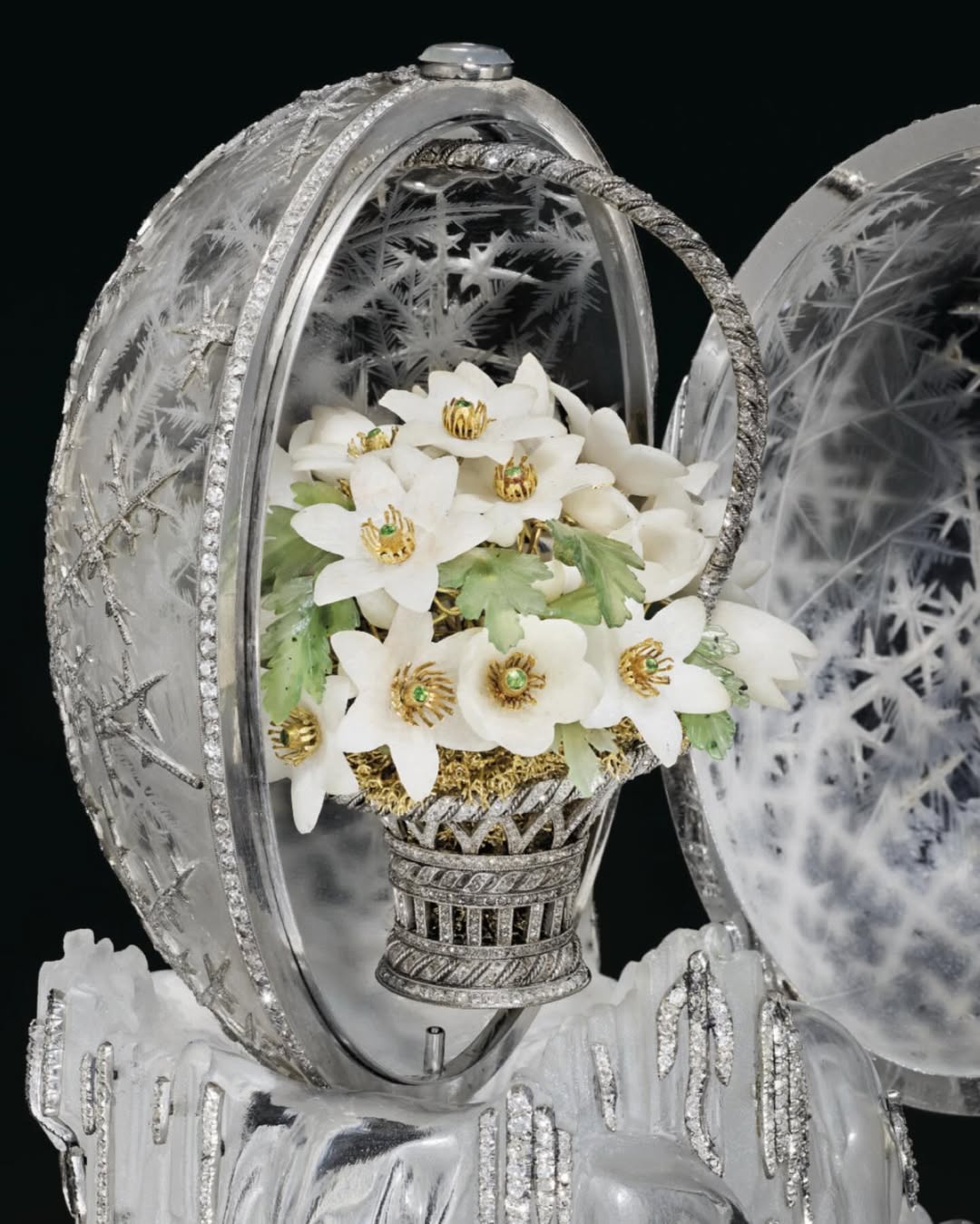

On December 2, Christie’s London witnessed a historic moment in the world of decorative arts when the Fabergé Winter Egg sold for £22.9 million ($30.2 million), shattering the auction record for any work by the legendary Russian jeweler. The sale marked the third time this extraordinary piece has set a world record, cementing the Winter Egg’s status as one of the most valuable and sought-after objects in the decorative arts market.
A Masterpiece Returns
The Winter Egg’s journey to the auction block began over a century ago in the workshops of the House of Fabergé in St. Petersburg. Commissioned by Tsar Nicholas II in 1913 as an Easter gift for his mother, Dowager Empress Maria Feodorovna, the egg represents the pinnacle of Imperial Russian craftsmanship. Nicholas paid 24,600 rubles for the piece—the third-highest price Fabergé ever charged for a work, and an astronomical sum considering the average Russian factory worker earned just 22 rubles per month.

The three-minute bidding battle that concluded on Tuesday exceeded Christie’s pre-sale estimate of £20 million, with the hammer falling at £19.5 million before fees. The identity of the buyer remains unknown, though Christie’s confirmed the seller was from a “princely collection,” reportedly the royal family of Qatar, who acquired the egg in 2002.
An Icon of Design and Innovation
What makes the Winter Egg truly exceptional is not just its provenance but its extraordinary artistic conception and execution. The piece was designed by Alma Pihl, one of the few female designers working in Fabergé’s predominantly male workshops. According to legend, Pihl conceived the design while gazing at frost patterns forming on her workshop window, imagining how to recreate the delicate beauty of ice crystals in precious materials.
The egg itself is carved from rock crystal, engraved on the interior with frost designs and adorned on the exterior with platinum snowflakes set with approximately 4,500 rose-cut diamonds. It rests on a base shaped to resemble melting ice, symbolizing the transition from winter to spring—a theme deeply resonant with Easter’s message of renewal and resurrection.
Opening the egg reveals its hidden “surprise”: a miniature platinum basket filled with white quartz wood anemones rising from a bed of gold moss. Each flower features gold wire stems and stamens, nephrite leaves, and a demantoid garnet center. The craftsmanship required to create this piece was extraordinary, particularly given the brittleness of rock crystal, which made carving exceptionally challenging.
A Tumultuous History
The Winter Egg’s journey from imperial palace to auction house mirrors the turbulent history of 20th-century Russia. After the October Revolution of 1917, the egg was seized by the Bolsheviks along with other imperial treasures. In desperate need of foreign currency, the Soviet government sold it to London jeweler Wartski between 1929 and 1933 for a mere £450—roughly $30,000 in today’s money.
The egg then passed through several British aristocratic collections before disappearing from public view for nearly two decades. It was considered lost until 1994, when it resurfaced at Christie’s Geneva and sold for 7.3 million Swiss francs (approximately $5.6 million), setting its first world record. Eight years later, in 2002, it appeared at Christie’s New York and broke its own record, selling for $9.6 million to what was reportedly the Qatari royal family.
The previous record for any Fabergé work at auction was held by the Rothschild Egg, which sold for £8.9 million (approximately $18.5 million) at Christie’s London in 2007. The Winter Egg’s 2025 sale price more than doubles that benchmark.
The Winter Egg Sale: Extreme Rarity Drives Value
The astronomical prices commanded by Imperial Fabergé eggs reflect their extreme scarcity. Between 1885 and 1916, the House of Fabergé created only 50 Imperial Easter Eggs for Tsars Alexander III and Nicholas II. Of these, 43 are known to survive. Seven remain missing, likely lost or destroyed during the Russian Revolution. Of the survivors, only seven remain in private hands—the rest are held in museum collections, including the Moscow Kremlin Museums, the Fabergé Museum in Germany, and several American institutions.

According to Kieran McCarthy, co-managing director at Wartski and a leading Fabergé expert, only three of the seven privately held eggs could realistically come to market. The Winter Egg’s appearance at auction marked the first time an Imperial Egg had been offered publicly in 23 years, making it an exceptionally rare opportunity for collectors.
Margo Oganesian, head of Christie’s Fabergé and Russian artworks department, described the Winter Egg as “the most spectacular, artistically inventive and unusual” of all 50 Imperial Eggs. Following the Winter Egg sale, she stated that the record price “reaffirmed the enduring significance of this masterpiece and celebrated the rarity and brilliance of what is widely regarded as one of Fabergé’s finest creations, both technically and artistically.”
Five Other Highlights from the Auction
The Winter Egg headlined a remarkable sale titled “The Winter Egg and Important Works by Fabergé from a Princely Collection,” which featured 48 lots from a single royal collection. The sale achieved a 91.6% sell-through rate with a total of £27.8 million ($35.7 million). Here are five other notable lots that captured collectors’ attention:
Hardstone Model of a Street Painter (Lot 22)
Sold for: £1,514,000 ($1.94 million)

This whimsical figure, executed in 1916 in Petrograd by modeller Boris Fredman Cluzel, represents one of Fabergé’s rarest categories of work. Only about 60 hardstone figure carvings were produced between 1908 and 1916, making them nearly as scarce as the Imperial Eggs themselves. The street painter is ingeniously assembled from multiple materials: sapphire eyes, cacholong face and hands, jasper cap and boots, purpurine shirt, and lapis lazuli trousers. He carries silver-mounted brushes and a jasper bucket on his back. Originally from the collection of Emanuel Nobel, the piece stayed within its £1.5-2 million estimate.
Jewelled Gold-Mounted Nephrite Miniature Sleigh (Lot 13)
Sold for: £736,600 ($945,000)
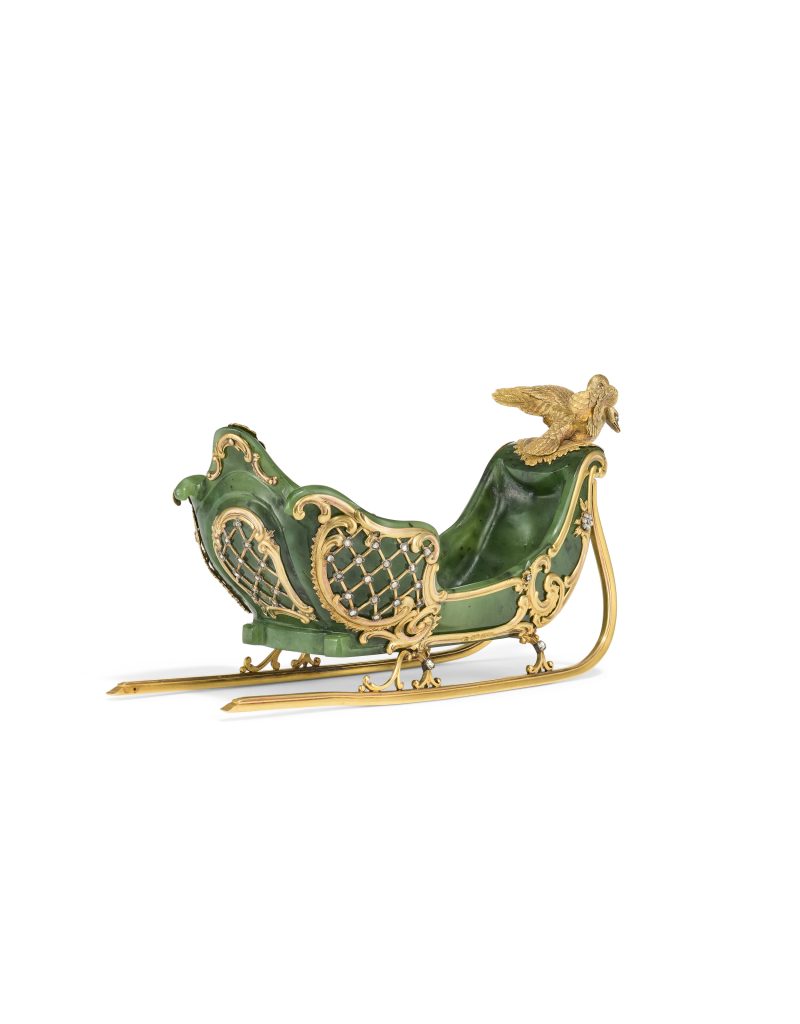
This exquisite miniature sleigh, executed circa 1890 in St. Petersburg, demonstrates Fabergé’s mastery of combining precious materials with creative design. Carved from nephrite and mounted in gold with jeweled details, the 15.2-centimeter piece was previously owned by Donna Simonetta Colonna, Duchess di Cesarò. It sold well above its £350,000-450,000 estimate, reflecting strong demand for high-quality Fabergé objects de vertu.
Design Album from Henrik Wigström’s Workshop (Lot 48)
Sold for: £508,000 ($652,000)

This remarkable archival piece offers a rare glimpse into the creative process at Fabergé’s workshops. Executed between 1911 and 1916 in St. Petersburg, the album comes from the workshop of Henrik Wigström, one of Fabergé’s most important workmasters. Such design albums are exceptionally rare survivors, making this lot particularly valuable to collectors and scholars interested in understanding how Fabergé’s masterpieces were conceived and developed. It was purchased by Faberge.
Guilloché Enamel Two-Color Gold-Mounted Bonbonnière (Lot 42)
Sold for: £304,800 ($391,000)

Originally from the famous Forbes Collection, this elegant bonbonnière (sweetmeat box) was executed between 1899 and 1903 in St. Petersburg. The piece exemplifies Fabergé’s mastery of guilloché enamel work, a technique involving engine-turned patterns beneath translucent colored enamel. Despite a modest estimate of £30,000-50,000, the bonbonnière achieved more than six times its low estimate, demonstrating the enduring appeal of Fabergé’s decorative objects.
Jewelled and Gold-Mounted Hardstone Model of a Cockerel (Lot 4)
Sold for: £254,000 ($326,000)

This charming 8.2-centimeter cockerel, executed circa 1911 in St. Petersburg, showcases Fabergé’s skill in transforming hardstone into lifelike animal figures. Also originally from Emanuel Nobel’s collection, the cockerel demonstrates the playful side of Fabergé’s output. Its sale price of more than three times the high estimate (£50,000-70,000) reflects the strong market for Fabergé’s animal carvings, which combine technical virtuosity with artistic charm.
A Market Milestone
The Winter Egg’s record-breaking sale represents more than just a single transaction—it signals the enduring strength of the market for exceptional decorative arts and the unique position that Fabergé’s Imperial Eggs occupy in the collecting world. With only a handful of these masterpieces potentially available for private acquisition, each appearance at auction becomes a landmark event.
As institutions continue to hold their Imperial Eggs in perpetuity and the number in truly private hands dwindles, the Winter Egg’s journey from imperial gift to auction record-setter may represent one of the last opportunities for collectors to acquire such a piece. Its sale reminds us that great works of art transcend their materials. Indeed, the Winter Egg’s value lies not in its diamonds and platinum, but in its ability to capture a fleeting moment of natural beauty and transform it into something eternal.
Featured images: Courtesy of Christie’s

Sewelo is a world where jewelry, watches, and objects come alive in a shimmering dance of fantasy. Through a literary lens, we celebrate the beauty and elegance that make these treasures more than just possessions.