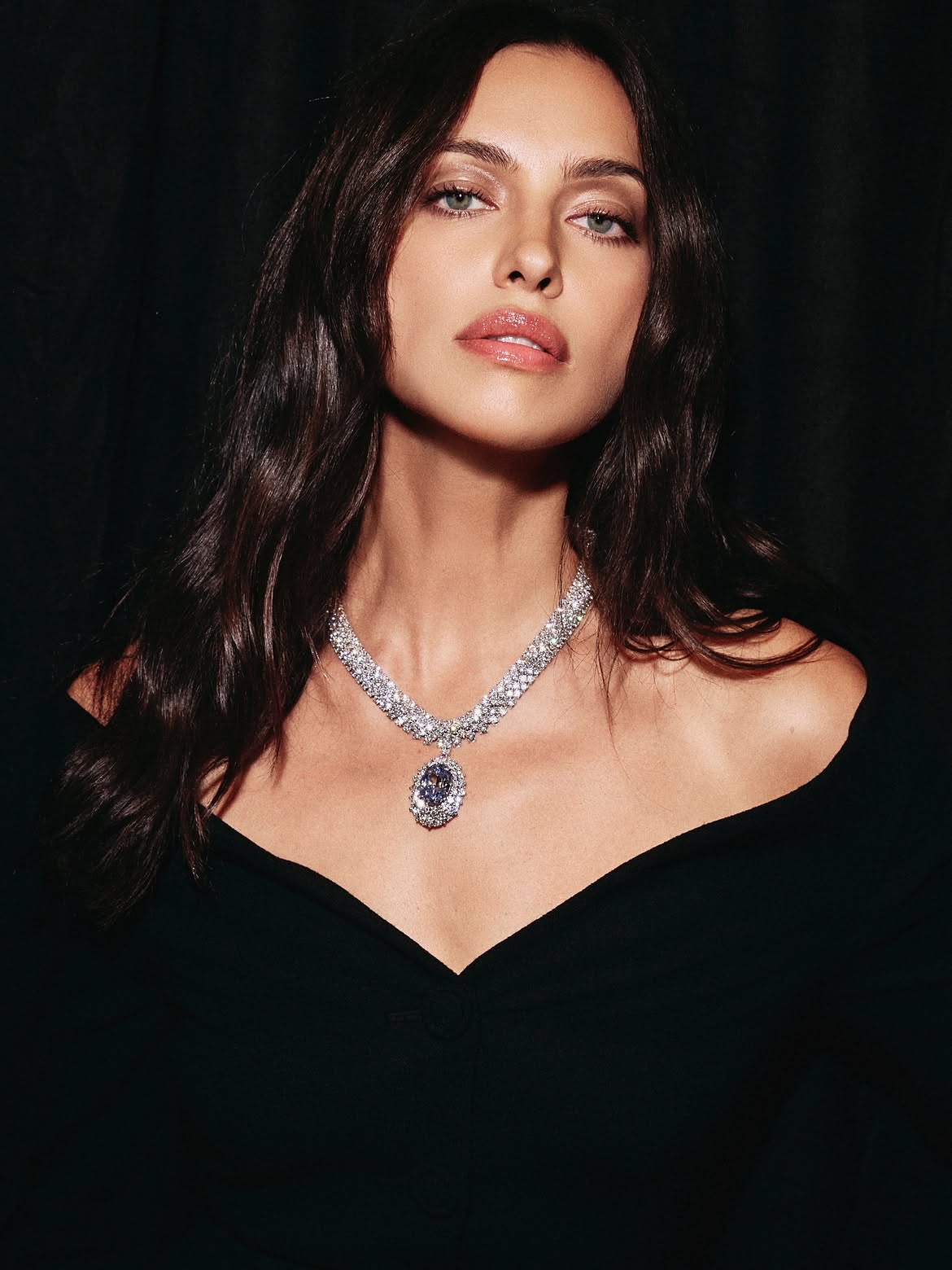

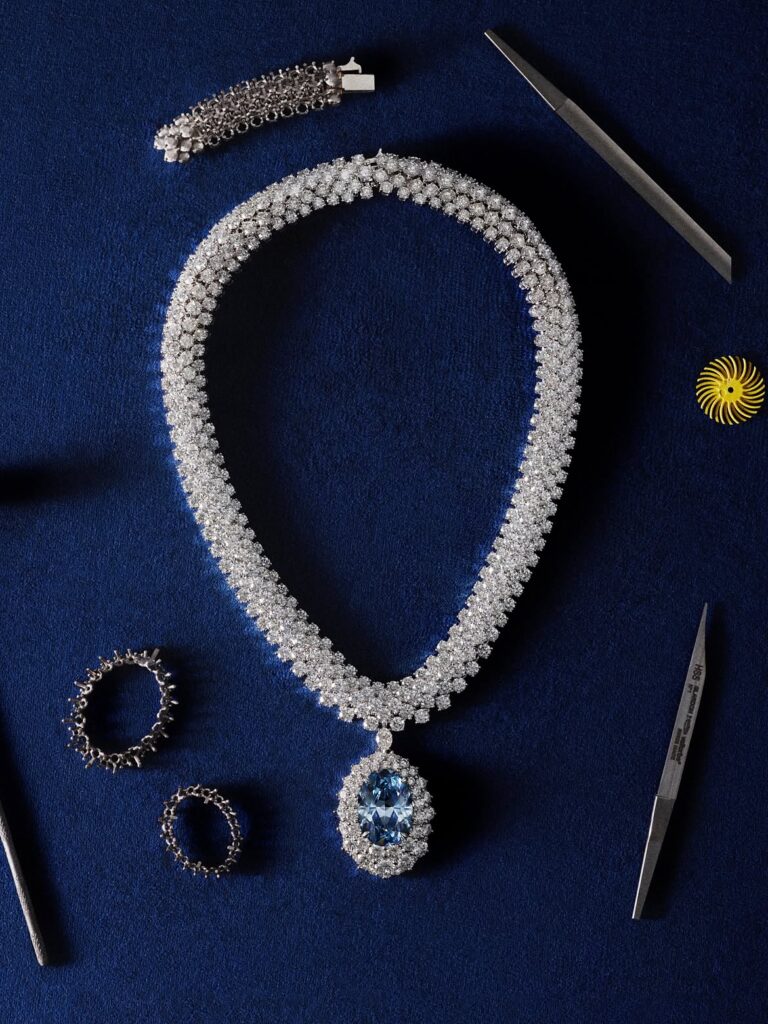
Imagine a river of white diamonds, cool and luminous, flowing around the neck. Now picture it pausing at the center, where a single oval stone of deep, inky blue gathers the light and holds it. The blue is not loud. It is calm, saturated, and slightly smoky, like water in a lagoon just before dusk.
That is the sight at the heart of the Messika Le Okavango Blue necklace, a high jewelry creation built around a 20.46-carat blue diamond from Botswana. The stone is the largest and rarest blue diamond ever found in the country. Valérie Messika, the Parisian designer known for her modern take on diamonds, set it in a necklace that lets the gem do the talking. It is part geology lesson, part love letter to a landscape, and entirely captivating, which is exactly why it’s our Piece of the Week.
Meet the Okavango Blue Diamond
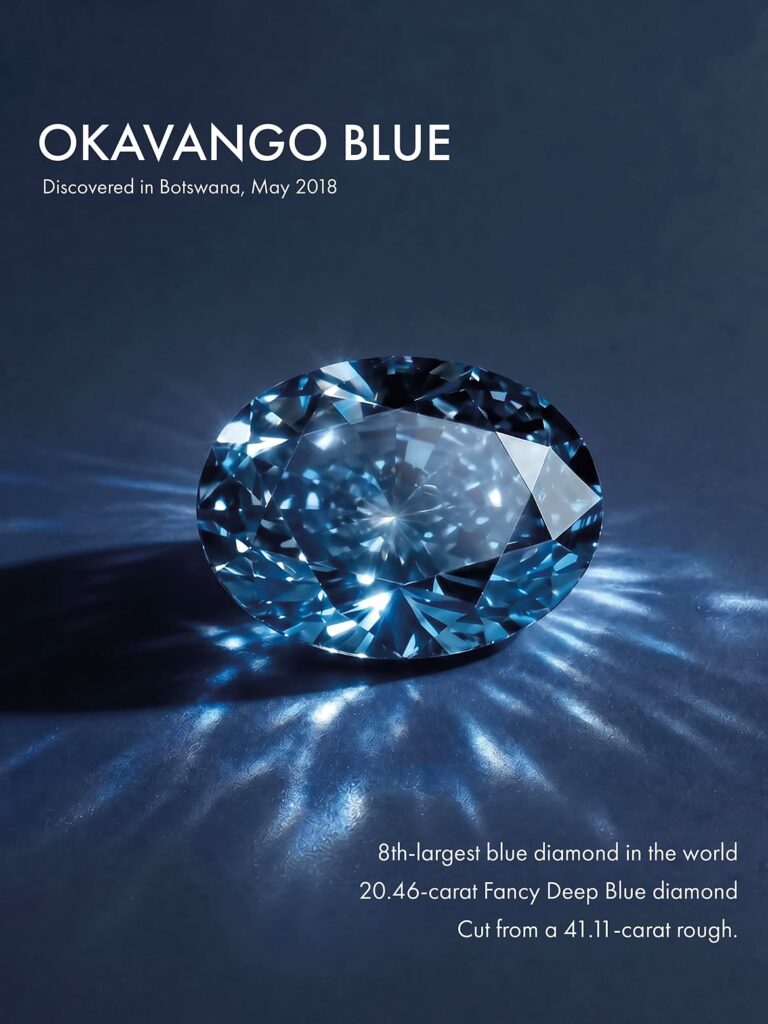
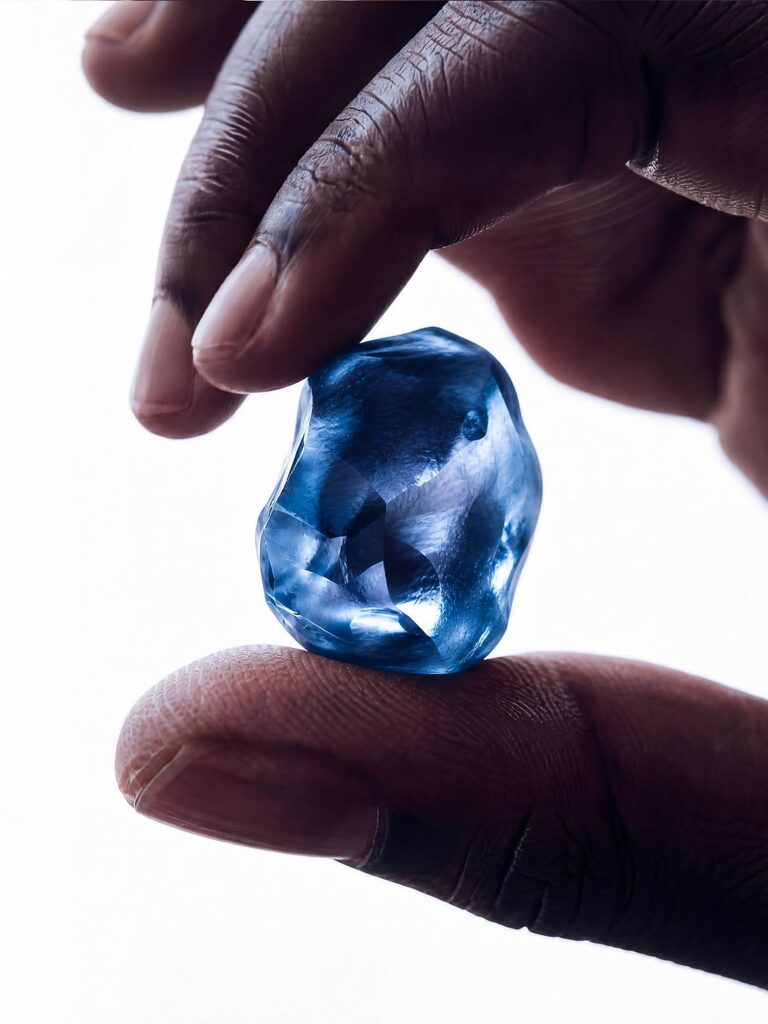
Every great jewel starts somewhere, and this one started deep underground. The diamond was discovered in 2018 at Botswana’s Orapa mine as a rough crystal weighing 41.11 carats. Rough diamonds don’t look like the sparkling stones we picture. They are often cloudy, uneven, and surprisingly plain. Turning one into a gem means cutting away a lot of it.
Here, that process left a polished oval of 20.46 carats, graded Fancy Deep Blue. Messika lists its clarity as VVS1, meaning any tiny internal marks are extremely hard to see, even under magnification. Its color has a subtle grey undertone that deepens the blue, and the house has given the shade its own name: “Austral Blue.” It is also reported to be the eighth-largest blue diamond found anywhere in the world.
It’s worth pausing on why blue diamonds are so special. Most diamonds are colorless or faintly yellow. A blue one is a geological accident, and a very rare one. Fancy blue diamonds owe their color to traces of boron that found their way into the crystal as it formed, billions of years ago. To be clear, carat weight is only part of the story. Color depth, clarity, and the overall character of the stone count just as much. But when a diamond is this large, this saturated, and this clean all at once, it enters an extremely small club.
The Okavango Blue had already been admired as a national treasure. Now it has a new chapter: it is the first time the stone has been set into jewelry, and Valérie Messika was entrusted with that task by the Government of Botswana.
How Valérie Messika Designed Le Okavango Blue
When you’re handed a gem like this, the hardest decision is often restraint. Messika has said her approach was to let the diamond speak for itself, and that philosophy shaped everything.
The Messika Le Okavango Blue necklace puts the stone at the center of a modern medallion, a clean oval frame that presents the diamond like a portrait. The proportions of that medallion turned out to be surprisingly demanding. According to the house, around 30 versions of it were made and refined before the final one was chosen. Each iteration tested how the frame would affect the way light moves through the stone, and whether it revealed the diamond’s blue or dulled it.
Think of it like framing a painting. The wrong frame can make a masterpiece look smaller, or make its colors look off. The right one makes you forget the frame exists. That’s what Messika was chasing: a setting so balanced that your eyes go straight to the blue.
Around the medallion, the design fades from bright white diamonds into softer lines, creating a gradient that eases the eye toward the center. The necklace sits on the collarbone in a V-shaped line, flattering and fluid. The result is a piece that’s bold and quiet at the same time, which is no small feat for a necklace carrying more than twenty carats of blue diamond.
More Than 500 Diamonds: The Art of the Rivière
A rivière is a classic of jewelry history. The word means “river” in French, and it describes a necklace of graduated diamonds that flows around the neck in a single, unbroken stream. Messika loves reinventing it, and here she gives it new life.
More than 500 diamonds are set along hidden, interlocking links, so the gold underneath moves almost like fabric. You don’t see the mechanism. You just see the diamonds and the way they ripple as the wearer moves. Messika reports a total diamond weight of 139.21 carats for the creation.
This is where high jewelry craftsmanship quietly shows off. Making a necklace this flexible, while holding that much stone weight and a monumental center gem, requires incredible precision. Each link must pivot smoothly. Each diamond must sit securely. And none of it can be visible.
The contrast is the magic. The central stone is monumental and still. The surrounding diamonds are lively and fluid. One feels like a mountain lake, the other like the river feeding it. And that brings us to the landscape that inspired the whole creation.
Botswana’s Okavango Delta and the Story Behind the Name
The Okavango River travels thousands of kilometers across southern Africa without ever reaching the sea. Instead, it fans out into the Kalahari Desert, creating the Okavango Delta: a maze of channels, lagoons, and green islands alive with wildlife. Seen from above, it looks like a map of blue braiding through green. It is one of the most remarkable places on Earth, a lush paradise surrounded by arid land.
That contrast is the idea behind Messika’s Terres de Contrastes high jewelry collection. Botswana is a land of striking opposites: the red and ochre sands of the Kalahari, the blue-green waters of the delta, and the white, glittering salt pans of Makgadikgadi at dusk. Other creations in the collection draw on those scenes, but the blue diamond carries the delta’s name and its deep-water palette.
It’s important to say that this is more than a pretty backdrop. Botswana is a diamond-rich nation, and its stones are part of its national story and heritage. The Okavango Blue was entrusted to Messika through a partnership with the Government of Botswana, which makes the necklace a collaboration between a French jewelry house and the country where the diamond was born. According to Le Figaro, the diamond belongs to the Government of Botswana and the jewel is not for sale. In that sense, the necklace is less a product than a showcase: a way of presenting one of Botswana’s natural treasures to the world.
Le Okavango Blue Took the Spotlight in Paris
Messika first revealed the necklace during Paris Couture Week in July 2026, and it returned to center stage on October 1, 2026, when the house presented its Terres de Contrastes collection in a runway show at the Grand Palais during Paris Fashion Week.
For the finale, model Irina Shayk walked out wearing the Messika Le Okavango Blue necklace. The moment brought the diamond into the fashion world’s gaze and linked it to the international high jewelry calendar. But the necklace’s lasting appeal doesn’t depend on a famous face. Shayk was a stunning messenger. The message was always the stone.
Why Le Okavango Blue Matters to High Jewelry Collectors
If you follow high jewelry, you’ll know that the best creations aren’t simply a matter of piling up carats. Understanding the distinction between high jewelry and fine jewelry helps explain why. High jewelry is about the extraordinary: rare gemstones, one-of-a-kind designs, and hundreds of hours of hand craftsmanship. It’s closer to art than to retail.
Here, four things meet at once. There is a remarkable natural gemstone. There is a named design made specifically for it. There is a creative vision that chose restraint over spectacle. And there is a clear provenance, a specific mine in a specific country, with a government partner behind it. Provenance may sound dry, but it’s what makes a stone feel like it has a biography.
For collectors drawn to the extraordinary world of colored gemstones, the Messika Le Okavango Blue necklace is a case study in how a great jewel is built: first by nature, then by patient human hands.
One more honest note. A piece like this isn’t a conventional retail item, so there is no sound basis for talking about resale value or investment returns. Its significance lies in the rarity of the gem, the thoughtfulness of the design, and the cultural story that surrounds it.
A Blue Diamond, Given a New Life
Go back to that first image: the calm blue at the center, the white river flowing around it. It’s a picture of two kinds of time. The diamond took billions of years to form. The necklace took a year of careful design and craft.
The Messika Le Okavango Blue necklace brings those timescales together, along with Botswana’s diamond heritage and the confidence of contemporary French high jewelry. It shows us that a great gemstone isn’t finished when it’s pulled from the earth. It’s only just begun, waiting for someone to listen to what it has to say.
If this creation has you curious about the latest high-jewelry creations, you’ll find there is no shortage of wonders this season. But few will be as quiet, and as deeply blue, as this one.
Featured images courtesy of Messika

Amanda Akalonu is dedicated to weaving together the worlds of jewelry, watches, and objects through a lens of literary storytelling.